The Question and the Evidence Ladder
How to hold an extraordinary claim without being gullible or dismissive.
There is a claim at the center of this book that sounds impossible: that empty space is not empty — that it has structure, energy, and a metric we might one day engineer — and that doing so could move a craft without pushing anything backward.
If your first instinct is to laugh, good. If your second instinct is to laugh before checking, that is the exact habit this book is built to defeat — in both directions. The lazy skeptic and the eager believer make the same mistake: they decide before they look. Our whole method is to look first, and to grade what we find honestly.
The two ways to be wrong
Being gullible means accepting a claim because it's exciting. Being dismissive means rejecting a claim because it's uncomfortable. Both skip the only step that matters: weighing the evidence for what it actually is.
The evidence ladder
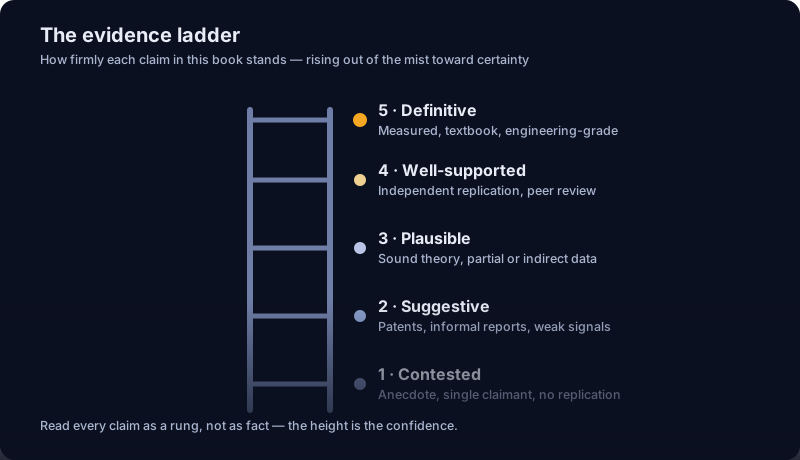
Throughout this book, every significant claim gets a tag. Not "true" or "false" — those are usually premature — but a rung on a ladder of confidence:
Definitive Definitive — experimentally established, reproduced, mainstream. Example: the Casimir effect (Chapter 2) is measured in labs worldwide.
Strong Strong — well-supported by primary sources and multiple independent lines, but not yet closed. Example: NASA's Lattice Confinement Fusion (Chapter 12).
Suggestive Suggestive — real anomalies or serious theory, but thin or contested evidence. Example: superfluid-vacuum interpretations (Chapter 5).
Speculative Speculative — mathematically coherent or argued by credible people, but essentially unproven. Example: usable zero-point energy extraction (Chapter 6).
Contested Contested — actively disputed, unreplicated, or with strong published refutations. Example: the "Pais Effect" patents (Chapter 7); the MH370 footage (Chapter 9).
A claim being Contested does not mean it is false. It means the honest position is uncertainty, and that anyone telling you it's settled — in either direction — is selling something.
The rule that keeps us honest: state your falsifier
For every major claim, we write down, in advance, what would prove it wrong. A claim that nothing could ever disprove is not a scientific claim — it's a belief wearing a lab coat.
Two clues that look like one
The single most common error in this field is mistaking echo for corroboration. Ten YouTube channels repeating the same claim is not ten pieces of evidence; it's one claim traced through ten mouths. Real confidence comes from independent streams agreeing — a patent, a lab measurement, and a theoretical prediction that didn't know about each other. Throughout, we distinguish the two.
This is why "extraordinary claims require extraordinary evidence" is not skeptic bullying — it's arithmetic. When your starting belief (the prior) is low, you need evidence that would be very unlikely under the boring explanation before you're rationally allowed to climb the ladder.
What this buys us
With this lens, we can do something most treatments of this material refuse to do: take the strongest version of these ideas seriously AND take the strongest criticism of them seriously — at the same time. We can say "this specific vacuum effect is real and measured" and "this specific propulsion claim is unproven and here's the best argument against it" in the same breath, without flinching.
That's the promise. Now let's go look at the vacuum.
“This is just a rhetorical dodge — dress speculation in tiers and a 'falsifier' line, and you can smuggle any fringe idea in under a veneer of rigor.”
A fair worry, and the only defense is consistency the reader can audit. The tiers are worth nothing if we quietly lower the bar for claims we like and raise it for claims we don't. So we invite exactly that audit: every chapter states its falsifier, and the most exciting propulsion claims land at Speculative and Contested — never laundered up to Strong by sitting next to the textbook physics. If you ever catch us doing otherwise, the method has failed, not succeeded.
Confidence ledger
- The evidence-ladder method is a sound epistemic tool. Definitive
- Falsifier for this chapter: if applying these tiers forced us to smuggle in a hidden double standard (a low bar for claims we like, a high bar for claims we don't), the method would be broken. We invite the reader to audit us for exactly that, chapter by chapter.
Sources
This is a method chapter; the "sources" are the epistemic tools it borrows, all canonical.
Primary / canonical
- Bayes & Price (1763), "An Essay towards solving a Problem in the Doctrine of Chances," Phil. Trans. R. Soc. 53, 370. DOI 10.1098/rstl.1763.0053. Public domain.
- K. Popper, The Logic of Scientific Discovery (Eng. ed. 1959) - falsifiability.
- E. T. Jaynes, Probability Theory: The Logic of Science (CUP, 2003) - modern Bayesian treatment.
The "extraordinary claims" norm - honest provenance
- M. Truzzi (1978), "extraordinary claims require extraordinary proof," Zetetic Scholar 1 - the modern phrasing; C. Sagan, Cosmos (1980, ep. 12) popularized it; the underlying idea is Laplace's.
The echo-vs-corroboration rule, made quantitative (beyond the source corpus)
- J. Ioannidis (2005), "Why Most Published Research Findings Are False," PLoS Med. 2(8):e124 (open access) - prior odds x power x bias; the arithmetic behind "independent replication is the unit of evidence."
- "Risk and Scientific Reputation: Lessons from Cold Fusion," arXiv:2201.03776 - why extraordinary energy claims rightly face a high bar (a running worked example in Ch. 12).
Independent corroboration vs. echo: the tools above come from separate traditions (probability theory, philosophy of science, metascience) that agree on the same discipline - the good kind of convergence this book is built to look for.