What Is the Vacuum? From Empty Space to a Structured Medium
The old aether, reborn as the quantum vacuum — and the lab experiment that proves empty space pushes back.
Ask most people what's left when you remove every atom from a box, and they'll say: nothing. Empty space. Zero.
Modern physics says the opposite, and it isn't a fringe opinion — it's the mainstream, Nobel-decorated core of the field. Empty space is a physical medium with structure and energy. The rest of this book is about what happens if you take that sentence completely seriously.
The aether never really died — it changed clothes
For centuries physicists believed in the aether: an invisible medium that light waves rippled through, the way sound ripples through air. In 1887 the famous Michelson–Morley experiment failed to detect it, and Einstein's relativity made the old mechanical aether unnecessary. Case closed — or so the textbook story goes.
But something strange happened on the way to "empty." Quantum mechanics and general relativity each, in their own language, re-populated the void:
- Quantum theory says the vacuum is the lowest-energy state of every field — and that lowest energy is not zero. Fields still jitter. Pairs of particles still flicker in and out of existence.
- General relativity says the vacuum carries a metric — a structure that encodes distances, time, and the bending we call gravity. Space itself has geometry.
Nobel laureate Frank Wilczek put it bluntly in The Lightness of Being: the old question of whether space is an empty stage or "the primary reality of which matter is a secondary manifestation" has been answered — "Today the third view is triumphant." The vacuum is the main character.
Zero-point energy: the jitter that never stops
Here is the first piece of hard physics. In quantum mechanics, even at absolute zero — all heat removed, all motion supposedly stopped — an oscillator still has energy. It cannot sit perfectly still, because perfect stillness would pin down both its position and its motion exactly, which the uncertainty principle forbids.
This is zero-point energy (ZPE) — the irreducible hum of the vacuum. It is not speculative; it is why liquid helium refuses to freeze solid under its own vapor pressure, and it shows up throughout chemistry and spectroscopy. The controversy in later chapters is never whether ZPE exists — it does — but whether it can be tapped or engineered.

The experiment that ends the argument: the Casimir effect
If the vacuum's energy were just bookkeeping, you could ignore it. But in 1948 the Dutch physicist Hendrik Casimir predicted something you can measure: put two uncharged metal plates extremely close together in a vacuum, and they will be pushed together by empty space itself.
Why? The gap between the plates only allows vacuum waves of certain sizes to fit — like a guitar string that can only vibrate at particular notes. Outside the plates, waves of every size are allowed. So there's slightly more vacuum "pressure" pushing in from outside than pushing out from between. The plates get shoved together, by nothing.
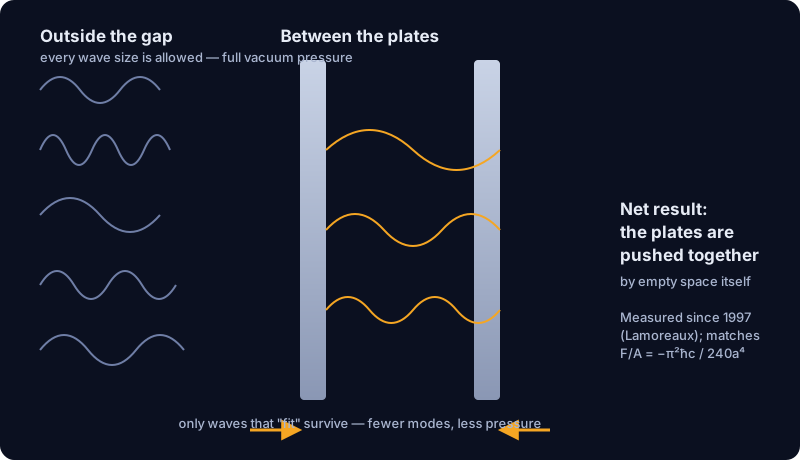
Definitive The Casimir effect is measured, reproduced, and textbook. This is the anchor of the whole book: the vacuum is demonstrably not nothing. Everything that follows is an argument about how far that fact can be pushed.
"Vacuum engineering" is a phrase a Nobelist coined
The leap from "the vacuum has structure" to "maybe we can alter it" is not something we invented. Nobel laureate T. D. Lee wrote in his standard textbook: "The experimental method to alter the properties of the vacuum may be called vacuum engineering… If indeed we are able to alter the vacuum, then we may encounter new phenomena, totally unexpected."
That single sentence is the seed of this entire field. A declassified U.S. Defense Intelligence document (Chapter 4) opens by quoting exactly this line before proposing that "empty space itself might be engineered to provide energy/thrust." Whether that proposal is genius or overreach is what we spend the rest of the book grading — carefully, one rung at a time.
What we've actually established
- The vacuum carries irreducible zero-point energy. Definitive
- The vacuum exerts measurable force (Casimir). Definitive
- The vacuum has a metric structure (next chapters). Definitive
- That this energy/structure can be usefully engineered for energy or propulsion. Speculative — the open question of this book.
“The vacuum energy is real but you can't use it — it's the ground state, and you can't extract work from the lowest energy level.”
This is the strongest and most important objection, and it's largely correct as stated — which is why we tag energy extraction as Speculative/Contested, not Definitive. There is a subtler point that keeps even the foundation honest: the physicist Robert Jaffe showed in 2005 that the Casimir force can be derived entirely from ordinary quantum electrodynamics — the fluctuating currents in the plates — without ever invoking zero-point energy at all, and it vanishes in the limit where the fine-structure constant goes to zero. So the Casimir effect proves the vacuum exerts a real force; it does not by itself prove there is a reservoir of extractable "free" ZPE. Pulling the plates back apart costs back the energy. Chapter 6 takes this head-on — flagging which proposed loopholes are real physics and which quietly violate thermodynamics.
Confidence ledger
- Zero-point energy exists. Definitive
- Casimir force is real and measured. Definitive
- Casimir force by itself proves extractable zero-point energy. Contested (Jaffe 2005: derivable without ZPE).
- The vacuum can be "engineered" for net energy/thrust. Speculative
- Falsifier for the foundational claim: if precision Casimir-force measurements had come back null, or matched a purely material (non-vacuum) explanation, the entire premise would collapse here. They didn't — the prediction holds to the measured percent-level. That's why we can build on it.
Sources
Primary
- H. B. G. Casimir (1948), "On the attraction between two perfectly conducting plates," Proc. Kon. Ned. Akad. Wetensch. B51, 793 - origin of F/A = -pi²h-bar c/240a⁴. (Public-domain KNAW scan held in the research corpus.)
- H. B. G. Casimir & D. Polder (1948), "The Influence of Retardation on the London-van der Waals Forces," Phys. Rev. 73, 360. DOI 10.1103/PhysRev.73.360.
- Zero-point energy E0 = ½h-bar-omega - Planck's "second theory" (1911); standard QM.
- T. D. Lee, Particle Physics and Introduction to Field Theory (1981) - "vacuum engineering" is genuinely Lee's term.
- F. Wilczek, The Lightness of Being (Basic Books, 2008) - "the Grid"; the mainstream anchor that a structured vacuum is orthodox QFT.
Independent corroboration (the Definitive tier)
- S. Lamoreaux (1997), "Demonstration of the Casimir Force in the 0.6 to 6 um Range," Phys. Rev. Lett. 78, 5 - first modern precision measurement.
- U. Mohideen & A. Roy (1998), Phys. Rev. Lett. 81, 4549 - AFM measurement to ~1%, a different apparatus in a different lab (genuine corroboration, not echo).
Answering the critics
- R. L. Jaffe (2005), "Casimir effect and the quantum vacuum," Phys. Rev. D 72, 021301 (arXiv:hep-th/0503158) - the force is derivable without zero-point energy, as a relativistic van der Waals force. Casimir proves the vacuum couples to matter; it does not by itself prove an extractable ZPE reservoir.
- K. Milton (1999), "The Casimir effect: physical manifestations of zero-point energy," arXiv:hep-th/9901011 - sign/geometry dependence (Boyer's repulsive sphere) undercuts "the vacuum always pushes inward."