The Zero-Point Field, Inertia, and Gravity
What if mass, inertia, and gravity are not built into matter — but are things the vacuum does to matter?
Push a shopping cart and it resists. Push harder to speed it up and it resists more. That resistance is inertia — and every physics student learns it as simply a property matter has, measured by mass, full stop.
But why does matter resist speeding up? "Because it has mass" is a label, not a reason. In the 1990s a few credentialed physicists asked the forbidden question. What if inertia is not built into matter at all? What if it is a force the vacuum exerts on matter that tries to accelerate? This chapter is about that question. Here the book leaves solid ground and climbs into serious-but-contested territory. We will mark every step.
Sakharov's dangerous idea: gravity might not be fundamental
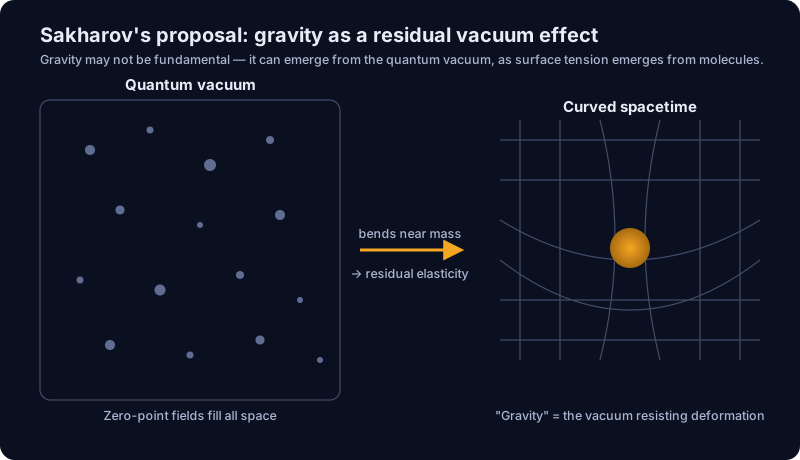
In 1967 the Soviet physicist Andrei Sakharov made a bold proposal. Sakharov built the hydrogen bomb and later won the Nobel Peace Prize. He suggested that gravity may not be a basic force at all. Instead it could be an emergent effect — a kind of springiness of the vacuum. It appears when the quantum fields that fill space are disturbed by matter. In this view, space bends the way a crowded room builds up pressure: not because bending is built in, but as a side effect of all the vacuum activity underneath.
Strong Sakharov's induced-gravity idea is respectable, published physics. Mainstream researchers still work on it. It does not prove gravity is "just" vacuum mechanics. But it makes the idea fair to explore, not crankish to mention.
The ZPF-inertia hypothesis
Building on this, Bernard Haisch, Alfonso Rueda, and Harold Puthoff published a striking idea (Physical Review A, 1994). They proposed that inertia is a reaction force from the zero-point field. Picture accelerating a charged particle through the vacuum's restless jitter (Chapter 2). The field pushes back. That push-back, added up over all matter, is what we have always called inertial mass.

Contested The specific 1994 derivation has been criticized. Later work — by the authors and by critics — found the original mechanism incomplete. And no experiment has shown that inertia can really be reduced this way. So we hold two things at once. The question is real, and real physicists asked it (Strong). But the claim that we can engineer inertia away is unproven (Contested).
Puthoff's Polarizable Vacuum: gravity as a change in the "thickness" of space
Harold Puthoff went further. He restated general relativity as the Polarizable Vacuum (PV) model. The standard view pictures gravity as curved spacetime. PV instead pictures the vacuum as an optical medium — like glass that gets denser near mass. Light and matter slow and bend near a star. In this picture that is not because the "shape" of space changed. It is because the vacuum there became optically "thicker."
Suggestive The PV approach reproduces the classic tests of general relativity — light bending, time dilation, the slow drift of Mercury's orbit — in the weak-field regime. That is why it is taken seriously as a restatement. Is it only an equal restatement, or a deeper description you could engineer? That exact question is what the U.S. defense document in the next chapter is built on.
Why this chapter matters for everything after
Suppose inertia and gravity are things the vacuum does to matter, not fixed properties of matter. Then in principle they are settings you could change, not constants you are stuck with. That "in principle" is doing enormous work, and we will not let it hide. Still, you cannot see why credible people chase inertia-reduction craft (Chapters 7–8) without one fact. The idea has a respectable, published lineage. It runs back to Sakharov and into the pages of Physical Review.
“These are just reinterpretations that make no new, tested predictions — so they're philosophy, not physics.”
A fair and serious charge. A reformulation that only reproduces known results, and never predicts something new and confirmed, earns Suggestive at best — not Strong. That's precisely how we've tagged PV and ZPF-inertia. The honest status is: legitimate questions, credible authors, incomplete answers, no confirming experiment yet. Anyone who tells you inertia-engineering is established is climbing the ladder without the evidence to stand on it.
Confidence ledger
- Sakharov induced-gravity is legitimate published physics. Strong
- The ZPF-inertia hypothesis was proposed by credentialed physicists in a top journal. Strong
- The specific claim that inertia can be reduced/engineered via the vacuum. Contested
- Polarizable-Vacuum reproduces weak-field GR. Suggestive
- Falsifier: a clean experiment showing an object's inertial mass is fixed regardless of any achievable local field manipulation would close the propulsion door these ideas open. To date the experiments are null-or-ambiguous — weaker than "confirmed wrong," but far weaker than "proven."
Sources
Primary
- B. Haisch, A. Rueda & H. Puthoff (1994), "Inertia as a zero-point-field Lorentz force," Phys. Rev. A 49, 678. DOI 10.1103/PhysRevA.49.678.
- A. Rueda & B. Haisch (1998), "Inertia as reaction of the vacuum to accelerated motion," Phys. Lett. A 240, 115 (arXiv:physics/9802031). (Downloaded.)
- H. Puthoff (2002), "Polarizable-Vacuum (PV) approach to general relativity," Found. Phys. 32, 927 (arXiv:gr-qc/9909037). (Downloaded.)
- A. Sakharov (1967), "Vacuum quantum fluctuations in curved space and the theory of gravitation," Sov. Phys. Doklady 12, 1040 (reprint Gen. Rel. Grav. 32, 365, 2000) - induced/emergent gravity.
Independent, mainstream anchors (beyond the source corpus)
- W. Unruh (1976), Phys. Rev. D 14, 870 - the established physics that an accelerated observer sees a thermal vacuum bath; the plausible core the HRP mechanism reaches for.
- M. Visser (2002), "Sakharov's induced gravity: a modern perspective," arXiv:gr-qc/0204062.
- E. Verlinde (2011), "On the origin of gravity and the laws of Newton," JHEP 04, 029 (arXiv:1001.0785) - emergent-inertia thinking is alive in serious (and heavily debated) theory.
Answering the critics
- The specific HRP ZPF-Lorentz-force derivation of inertia is disputed; any such model must reproduce the measured equality of inertial and gravitational mass - MICROSCOPE (2022) confirms it to ~1e-15, a hard falsifier on any mass-altering scheme.
Echo caution: several of these papers share authors (Haisch/Rueda/Puthoff). That is one research line, not four independent ones - Sakharov, Unruh and Verlinde are the genuinely independent anchors.