The Metric Tensor, Warp Drives, and Wormholes
The precise idea behind engineering space — and the honest gap between what the math allows and what you can build.
This book is named for a single mathematical object: the metric. It is the most important idea in the whole story. Good news: its core is easy to grasp. Once you have it, "engineering spacetime" stops being mystical. It becomes a specific, if bold, engineering target.
The metric is the universe's ruler
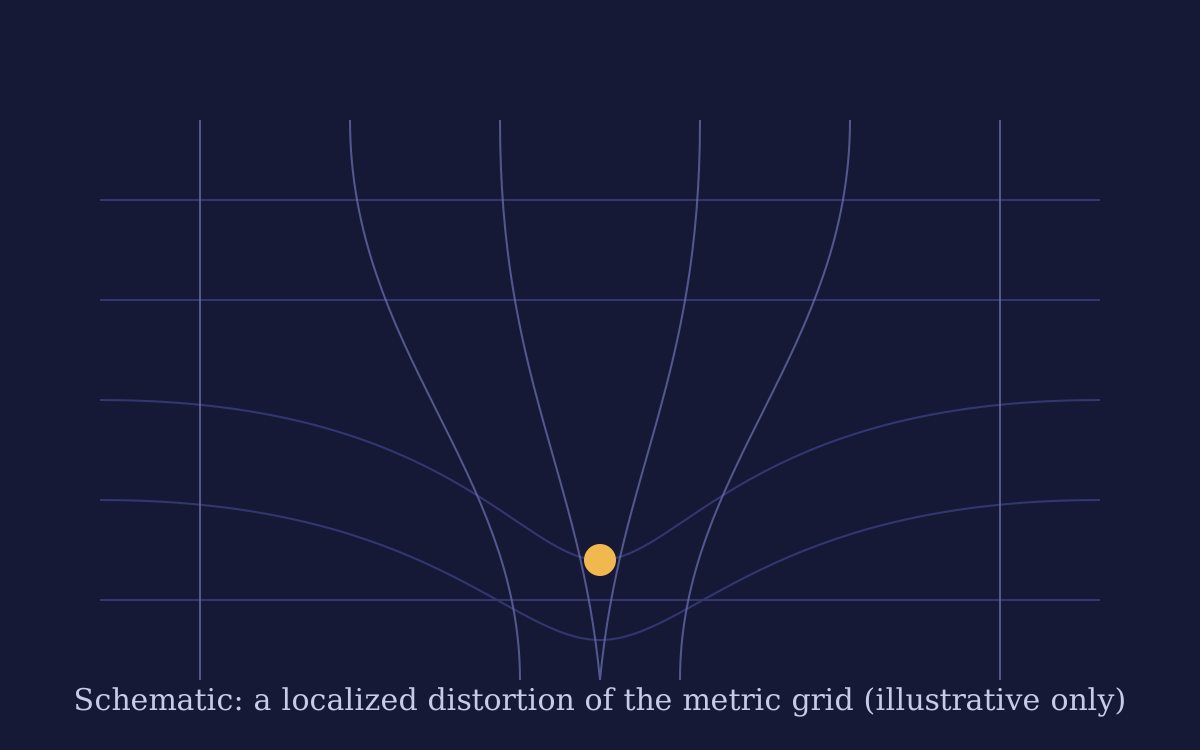
Spacetime does not come with distances printed on it. The metric tensor, written gᵤᵥ, is the rulebook. It tells you the real distance and elapsed time between two nearby events. Change the metric, and you change what "one meter" and "one second" mean at that spot.
Alcubierre's warp drive: legal under Einstein
In 1994 the Mexican physicist Miguel Alcubierre wrote down a metric that does exactly this. His solution contracts space in front of a craft and expands it behind. That carries the craft forward inside a flat "bubble." The ship never locally moves faster than light. It sits still in its own patch of calm space while the space around it moves. Relativity's speed limit applies to motion through space. Alcubierre found a loophole: move space instead.
Definitive As mathematics, the Alcubierre metric is a valid, published solution of Einstein's equations. This is not fringe. It is in textbooks and taught in relativity courses. The same holds for Morris–Thorne traversable wormholes (1988). They show Einstein's equations allow tunnels that connect distant regions.

The catch, stated plainly: you need negative energy
Here honesty separates this book from hype. To hold a warp bubble or a wormhole open, those same equations demand a strange ingredient. You need a region of negative energy density — matter that weighs less than nothing. That breaks what physicists call the energy conditions.
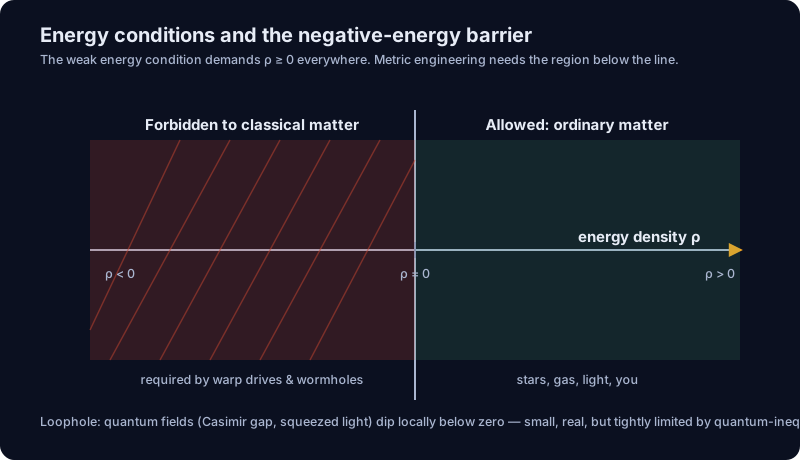
Speculative Small negative-energy densities are real and measured (Casimir, squeezed light). The large, sustained negative energy a real warp drive would need is far beyond anything shown so far. Mathematical possibility is not buildability. This sentence is the load-bearing beam of the whole book.
The live 2021 debate: how physical can a warp drive be?
This is not a settled museum piece. It is an active research front, and recent results cut both ways. In 2021 Alexey Bobrick and Gianni Martire published "Introducing physical warp drives" (Classical and Quantum Gravity). They reframed all warp drives as one general class. They showed that slower-than-light "warp shells" can be built from positive energy — no exotic matter needed just to hold one. That strengthens the modest version of the idea.
But the discipline arrives in the same breath. Erik Lentz (2021) claimed positive-energy warps that actually move. Santiago, Schuster, and Visser (2021) hit back with a general theorem: any warp drive that actually moves must break the null energy condition. So it needs negative energy after all. An older bound agrees. Pfenning and Ford (1997) checked Alcubierre's own solution. For a human-scale bubble, the required negative energy is astronomically large, and the bubble wall is thinner than an atom.
Suggestive Static, positive-energy warp shells may be physically permissible (Bobrick–Martire). Contested A moving warp drive with globally positive energy currently fails peer review (Santiago–Schuster–Visser); the negative-energy wall stands.
The document that took this seriously — on the government's dime
In 2010 the U.S. Defense Intelligence Agency released a reference document (later via FOIA). Its title: "Advanced Space Propulsion Based on Vacuum (Spacetime Metric) Engineering." Harold Puthoff wrote it under the Pentagon's advanced-aerospace program. It is the source of this project's name. In sober government prose, it lays out the chain we have been building. The vacuum is a structured, energetic medium (Chapter 2). General relativity says that medium carries a metric (this chapter). So engineering the metric is "not a priori ruled out" — you could alter time rate, distance, the local speed of light, effective mass, even produce "gravity/antigravity forces."
Suggestive The document is real, citable, and unclassified. It frames metric engineering as a serious long-range research target. That is notable — but it is not proof any of it works. A funded study shows institutional interest, not a working device. We hold that line firmly.
“Warp drives are science fiction — the energy requirements are absurd and probably impossible.”
Largely true, and we agree more than the hype-merchants would like. Pfenning–Ford put the negative energy for a macroscopic Alcubierre bubble at a mass-equivalent many times that of the visible universe, packed into a sub-atomic shell; Van Den Broeck's 1999 "bottle" trick and later refinements cut that dramatically on paper, but "less astronomically impossible" is not "feasible," and Santiago–Schuster–Visser show any moving drive still breaks the null energy condition. The correct posture is the one we hold: the math is real and beautiful; the engineering is unproven and may be impossible; and anyone collapsing that distinction — in either direction — has left the evidence behind.
Confidence ledger
- The metric tensor and general relativity. Definitive
- Alcubierre warp metric & Morris–Thorne wormholes as valid GR solutions. Definitive
- Small negative-energy densities exist. Definitive
- Subluminal positive-energy "warp shells" are permissible (Bobrick–Martire 2021). Suggestive
- Buildable macroscopic moving warp/wormhole engineering. Speculative to Contested
- The DIA DIRD exists and frames metric engineering as a research target. Definitive (the document); its conclusions remain Speculative.
- Falsifier: a firm proof that quantum inequalities forbid ever assembling sufficient sustained negative energy would kill the moving-warp route specifically. Santiago–Schuster–Visser tighten the door; it is narrow, not yet provably shut.
Sources
Primary
- M. Alcubierre (1994), "The warp drive: hyper-fast travel within general relativity," Class. Quantum Grav. 11, L73 (arXiv:gr-qc/0009013). (Downloaded.)
- M. Morris & K. Thorne (1988), "Wormholes in spacetime and their use for interstellar travel," Am. J. Phys. 56, 395. DOI 10.1119/1.15620.
- H. Puthoff (2010), "Advanced Space Propulsion Based on Vacuum (Spacetime Metric) Engineering," JBIS 63, 82 (arXiv:1204.2184) - the DIA DIRD's published cousin; the project's namesake. (Downloaded.)
- E. Davis (2004), "Teleportation Physics Study," AFRL-PR-ED-TR-2003-0034, DTIC ADA425545 (corrected accession; not ADA416108). (Downloaded.)
The live modern debate (independent, peer-reviewed - beyond the source corpus)
- A. Bobrick & G. Martire (2021), "Introducing physical warp drives," Class. Quantum Grav. 38, 105009 (arXiv:2102.06824) - subluminal warp shells from positive energy.
- E. Lentz (2021), "Breaking the warp barrier," Class. Quantum Grav. 38, 075015 (arXiv:2006.07125) - a contested positive-energy soliton claim.
- C. Van Den Broeck (1999), "A warp drive with more reasonable total energy requirements," arXiv:gr-qc/9905084.
Answering the critics (the honesty core)
- M. Pfenning & L. Ford (1997), "The unphysical nature of warp drive," arXiv:gr-qc/9702026 - quantum-inequality bound: astronomical negative energy, sub-atomic bubble wall.
- S. Santiago, J. Schuster & M. Visser (2021), "Generic warp drives violate the null energy condition," arXiv:2105.03079 - the strongest current refutation; directly rebuts positive-energy moving-warp claims.
Corroboration vs. echo: Lentz and Santiago-Schuster-Visser are genuinely independent groups reaching opposite conclusions - a real scientific dispute, not an echo chamber.