Superfluid Vacuum Theory: The Vacuum as a Quantum Fluid
Volovik's model — where particles and gravity emerge as ripples on a cosmic condensate.
Chapter 2 said the vacuum is a medium. This chapter asks the next question. What is it made of, and does it flow? The most developed answer does not come from particle physics. It comes from the study of ultracold liquids. And it is strange, beautiful, and surprisingly testable.
From a helium droplet to the universe
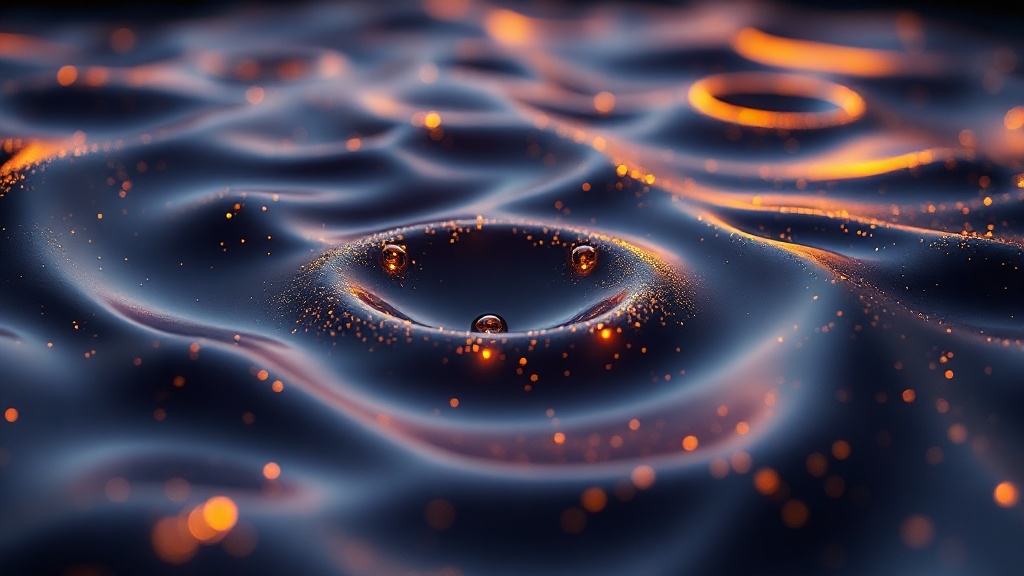
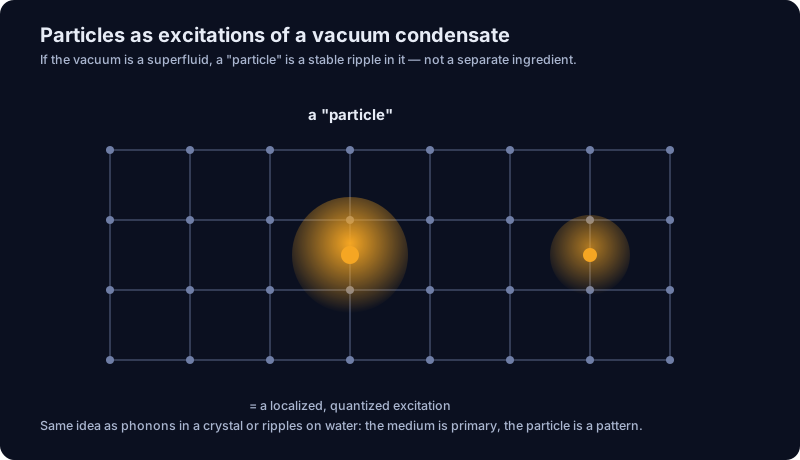
The Russian-Finnish physicist Grigory Volovik spent a career studying superfluid helium-3. This liquid is so cold it flows without friction. It also hosts strange, ordered quantum patterns. In his 2003 book The Universe in a Helium Droplet, he noticed something deep. The math for the low-energy ripples in superfluid ³He looks exactly like the math of the particles and forces in our universe. Electrons, photons, even a gravity-like field appear as collective excitations — as sound-and-vortex patterns in the fluid — not as basic building blocks.
Turn that around and you get Superfluid Vacuum Theory. Perhaps our vacuum is itself a kind of quantum condensate. Then everything we call "a particle" is just a ripple in it.
Why physicists take the analogy seriously: analogue gravity
This is not just poetry. There is a rigorous, mainstream line of work: Barceló, Liberati, and Visser's "Analogue Gravity" review. It shows that flowing fluids and Bose–Einstein condensates reproduce curved-spacetime physics for the ripples inside them. A fluid flowing faster than its own wave speed makes a "sonic horizon" — an acoustic black hole that sound cannot escape. In 2016 Jeff Steinhauer reported the analogue of Hawking radiation leaking from such a horizon in a BEC.
Strong That a curved-spacetime metric emerges for ripples in a real quantum fluid is established, lab-demonstrated physics. This is the solid ground the chapter stands on.
The prize: taming the worst prediction in physics
Superfluid vacuum theory offers a tempting bonus. Standard quantum field theory predicts the vacuum's energy should be enormous. This is the famous cosmological-constant problem. Theory overshoots what we observe by up to 120 orders of magnitude — the worst failure in the history of physics. Volovik argues that a self-sustained quantum liquid in balance must have almost zero net vacuum energy at rest. It becomes small and nonzero only when the medium is disturbed. If he is right, the problem dissolves — not by fine-tuning, but by the nature of the medium itself.
Suggestive The cosmological-constant argument is elegant and truly motivating. But no one has shown it survives once you add realistic matter and quantum corrections. Promising, not proven.
Where the discipline bites
Suppose our vacuum really were a superfluid with a preferred rest frame. Then it would usually produce a tiny violation of Lorentz invariance. Light of different energies would travel at slightly different speeds. Or a faint "aether wind" would show up at high energy. Physicists have looked hard — using gamma-ray bursts from billions of light-years away and high-energy neutrinos. They found nothing, down to about the Planck scale. That squeezes the crudest versions of the theory hard. It is a real falsifier, already partly cashed in.
“Fluids reproduce the KINEMATICS of curved spacetime — a metric for the ripples — but they have never reproduced the full DYNAMICS, Einstein's equations themselves. So the analogy inspires; it does not establish that our vacuum is a superfluid.”
This is the honest expert objection, and we concede it. Getting an effective metric for quasiparticles is one thing; deriving the Einstein field equations that say how that metric responds to energy is a harder, unsolved problem for these models. That is exactly why we cap "our vacuum literally is a superfluid" at Suggestive rather than Strong, and note the Lorentz bounds are already trimming the field. Volovik's own value is not a finished theory of everything — it is a proof-of-concept that spacetime can be emergent, and a specific, falsifiable school for pursuing it.
Confidence ledger
- Curved-spacetime physics emerges in real quantum fluids (analogue gravity). Strong
- Volovik's ³He model reproduces key Standard-Model / gravity features as emergent. Strong (as a theoretical model).
- A superfluid vacuum naturally resolves the cosmological-constant problem. Suggestive
- Our physical vacuum literally is a superfluid condensate. Suggestive → Contested
- Falsifier: Lorentz-violation or preferred-frame signatures at accessible energies. Current gamma-ray-burst and neutrino bounds already disfavor the naive versions — the theory survives only in its most carefully Lorentz-preserving forms.
Sources
Primary
- G. Volovik, The Universe in a Helium Droplet (Oxford UP, 2003) - the canonical text. Open statements of the same arguments:
- G. Volovik (2006), "From Quantum Hydrodynamics to Quantum Gravity," arXiv:gr-qc/0612134. (Downloaded.)
- G. Volovik (2008), "On the cosmological constant problem," arXiv:0801.2554. (Downloaded.)
Independent corroboration - emergent spacetime is real in the lab (beyond the source corpus)
- C. Barcelo, S. Liberati & M. Visser (2011), "Analogue Gravity," Living Rev. Relativity 14, 3 (open access) - the rigorous mainstream review of curved-spacetime physics emerging in fluids/BECs.
- J. Steinhauer (2016), "Observation of quantum Hawking radiation in an analogue black hole," Nature Physics 12, 959 (arXiv:1510.00621).
- K. Zloshchastiev, logarithmic-BEC Superfluid Vacuum Theory (e.g. arXiv:0906.4282) - a second, independent SVT school distinct from Volovik (corroboration, not echo).
Answering the critics
- S. Liberati (2013), "Tests of Lorentz invariance: a 2013 update," arXiv:1304.5795 - a literal superfluid vacuum predicts a preferred frame; Fermi-LAT/IceCube bounds squeeze the naive versions to near/above the Planck scale.
- Emergent-gravity-from-a-medium reproduces the kinematics (a metric for quasiparticles) but has historically struggled to yield the full dynamical Einstein equations - an open problem, stated as such.