Getting Energy From the Vacuum — and the Thermodynamics Objection, Answered
The dynamical Casimir effect, quantum energy teleportation, and where the honest line sits on 'free energy.'
This is the chapter where the money is. So it is where the fraud has always been. "Limitless free energy from the vacuum" is a promise that has funded a century of cranks — and a few serious physicists. The only way through is to hold two things at once. Grip the strongest skeptical objection in one hand and the strongest real result in the other. Refuse to let go of either.
The objection, stated at full strength
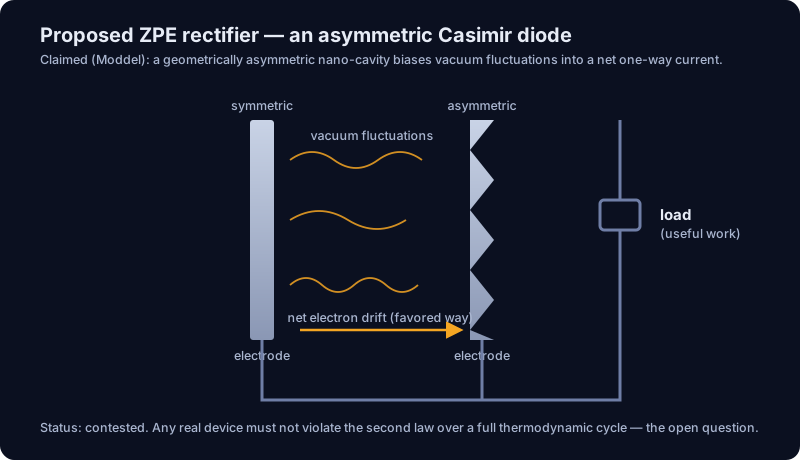
The vacuum is the ground state — the lowest-energy setting there is. By definition, there is no lower state to fall into. So imagine a device that cycles back to where it started and pulls out net energy on the way. That is a perpetual-motion machine of the second kind. Assembling two Casimir plates releases energy. Pulling them apart costs exactly that energy back. No net cycle. This is not a detail you can finesse. It is the wall every vacuum-energy claim must climb.
Remarkably, the person who states this most clearly is a proponent. Garrett Moddel's 2019 review in Atoms goes through the schemes one by one. It shows why most zero-point-energy extraction ideas fail on thermodynamics. Only then does he argue for one narrow surviving window. That is exactly the honesty this field usually lacks.
The real result: shaking the vacuum makes light
Now the other hand. In 2011 Christopher Wilson and colleagues did something that sounds impossible. They made real photons appear out of the vacuum by moving a mirror. Not a metaphor — real, detectable microwave light. They shook the boundary of a superconducting circuit billions of times per second. That was so fast the vacuum's virtual photon pairs could not recombine. Some got "promoted" to real photons. This is the dynamical Casimir effect (DCE). It has since been reproduced on several platforms.
Definitive The DCE is real and measured. But read the honest lesson: the energy is supplied by the driving. The vacuum converts work. It does not donate it.
Quantum energy teleportation: the subtle, legal loophole
There is one "energy from the vacuum" idea that is fully rigorous, peer-reviewed physics: Masahiro Hotta's Quantum Energy Teleportation (QET). You measure the vacuum at one point and send the plain result to a partner elsewhere. The partner can then pull a little energy from their local vacuum sooner than they otherwise could. This works because the two regions are quantum correlated. It looks like magic, but the books balance. The measurement itself injects at least as much energy as is later pulled out. Energy conservation and the second law stay untouched.
Strong QET is genuine physics — but it is emphatically not free energy. It just moves energy around, paid for in full at the measurement step. Telling it apart from perpetual-motion ZPE claims is the whole point.
What survives
- The vacuum's force is engineerable (repulsive and tailored Casimir forces are demonstrated). Strong
- Vacuum fluctuations can be converted to real photons (DCE). Definitive
- A standalone device drawing net-positive cyclic power from the ground state. Contested — none exists with a closed energy ledger.
“But the dynamical Casimir effect PROVES you can get real energy out of the vacuum — so limitless vacuum power is just an engineering problem away.”
This is the field's most seductive move, and it fails on the ledger. The DCE converts the mechanical work used to shake the mirror into photons; independent analyses (and the Wilson experiment's own energy accounting) show you never get out more than the driving put in. Recall Jaffe's 2005 result from Chapter 2: even the static Casimir force can be derived without any ZPE reservoir at all, which undercuts the picture of a "tank" waiting to be drained. Real, subtle vacuum effects exist — Chapter 2's force, DCE, QET — and every one of them balances its books. A net-positive standalone device would have to close the complete ledger, including its own actuation, and survive independent replication. To date, not one has.
Confidence ledger
- Dynamical Casimir effect converts vacuum fluctuations to real photons. Definitive
- Quantum Energy Teleportation extracts usable energy from a correlated ground state, consistently. Strong (and it is not free energy).
- Casimir forces/diodes are engineerable in sign and magnitude. Strong
- Net-positive, cyclic, standalone power from the ZPE ground state. Contested
- Falsifier for the extraction claim: produce a device whose complete energy ledger — including actuation and measurement — is net-positive over a closed cycle, and that survives independent replication. None exists. Until one does, "vacuum power" stays behind the thermodynamic wall.
Sources
Primary
- C. Wilson et al. (2011), "Observation of the dynamical Casimir effect in a superconducting circuit," Nature 479, 376 (arXiv:1105.4714) - real photons from the vacuum; Definitive. (Downloaded.)
- M. Hotta (2011), "Quantum Energy Teleportation: An Introductory Review," arXiv:1101.3954 - rigorous vacuum-energy extraction that conserves energy and obeys the 2nd law (the extractor pays via measurement). (Downloaded.)
- G. Moddel & O. Dmitriyeva (2019), "Extraction of Zero-Point Energy from the Vacuum," Atoms 7(2), 51 (arXiv:0910.5893) - notably even-handed: catalogs why most ZPE schemes fail thermodynamically. (Downloaded.)
Independent corroboration / engineering kernel (beyond the source corpus)
- M. Hotta, J. Matsumoto & G. Yusa (2014), "Quantum energy teleportation without a limit of distance," Phys. Rev. A 89, 012311 (arXiv:1305.3955).
- A. Rodriguez, F. Capasso & S. Johnson (2011), "The Casimir effect in microstructured geometries," Nature Photonics 5, 211 - engineered/repulsive Casimir forces; the legitimate seed of "Casimir diodes."
- V. Dodonov (2020), "Fifty Years of the Dynamical Casimir Effect," Physics 2(1), 67 - independent DCE demonstrations across platforms.
Answering the critics (the chapter's spine)
- The thermodynamic objection stated properly: the ZPE is the ground state, so a standalone cyclic engine drawing net work from it is a perpetual-motion machine. Moddel (2019) above states this against his own proposals.
- D. Sheehan (ed.), Quantum Limits to the Second Law (AIP Conf. Proc. 643, 2002) - the serious venue where such challenges are debated, and remain unwon.