Electromagnetic Metric Engineering: The Pais Effect
The Navy's UFO patents — what they actually claim, what attested to them, and why 'patented' is not 'proven.'
In 2016 the U.S. Navy began filing patents so extraordinary they read like science fiction. One was a craft that flies by cutting its own inertial mass — its resistance to being sped up or slowed down. Others: a room-temperature superconductor, a compact fusion device, and a generator of high-frequency gravitational waves. The inventor, Dr. Salvatore Cezar Pais, worked at the Naval Air Warfare Center. Here a real government signature meets a claim mainstream physics rejects. The tension has to be handled with care.
Get the documents right first
Sloppy sourcing has muddied this story, so we pin the primary records exactly:
- US10144532B2 — "Craft using an inertial mass reduction device," granted 4 December 2018. This is the famous "UFO patent."
- US20170313446A1 — the earlier published application for that same craft invention (it issued as US10144532B2 above). It is not a separate gravitational-wave patent, though it is often mislabeled as one. Same invention, two document numbers — a textbook case of names and numbers not being evidence.
- US10322827B2 — "High frequency gravitational wave generator," granted 18 June 2019. This is the real gravitational-wave patent. It invokes the Gertsenshtein effect: turning electromagnetic waves into gravitational waves inside a magnetic field.
- US20190058105A1 — the piezoelectric room-temperature-superconductor application, which the Navy abandoned in November 2019 after an unanswered USPTO rejection.
Definitive The patents exist and are assigned to the U.S. Navy. That is a matter of public record. Everything after this sentence is where the honesty is required.
What the "Pais Effect" claims
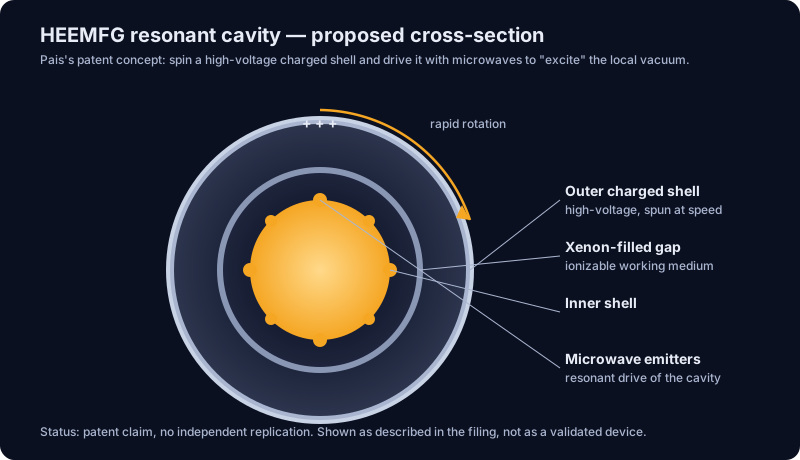
Pais's central idea is this. Spin and vibrate an electrically charged object at extreme frequencies. That builds an electromagnetic flux so intense it polarizes the vacuum itself. Locally, this would restructure the quantum vacuum, cut the object's inertial mass, and make its own gravitational field. In effect, it is a proposed electromagnetic route to the metric engineering of Chapter 4 and the inertia engineering of Chapter 3.
The one piece of real evidence — and what it is not
The strongest thing the Pais case has is not a measurement. It is an attestation. When a patent examiner balked, Dr. James Sheehy stepped in. As Chief Technology Officer of the Naval Aviation Enterprise, he formally told the USPTO the invention was "operable." He warned that China was chasing similar technology, and he pointed to an experimental demonstration. Reporters at The War Zone obtained this correspondence via FOIA.
That is genuinely notable — and it is also exactly where the evidence ladder earns its keep.
Contested A patent grant and a CTO's attestation are not scientific evidence that a physical effect is real. This is a point of category, not of degree. Patents test paper claims, not nature.
The skeptical verdict, stated plainly
Over roughly two years of reporting, nearly every physicist The War Zone's journalists asked said the same thing. The Pais Effect has no basis in known physics, and the patent language reads as pseudoscientific jargon. Several Pais patents have since lapsed for non-payment of fees, and the superconductor application was abandoned. In other words, the Navy itself did not keep them alive. And no independent lab has reported detecting the claimed inertial-mass reduction or gravitational-wave signal at the patents' stated drive conditions.
“These are just patents full of buzzwords. A government agency patenting something — even swearing it's 'operable' — tells you nothing about whether it violates the laws of physics. No one has ever replicated any of it.”
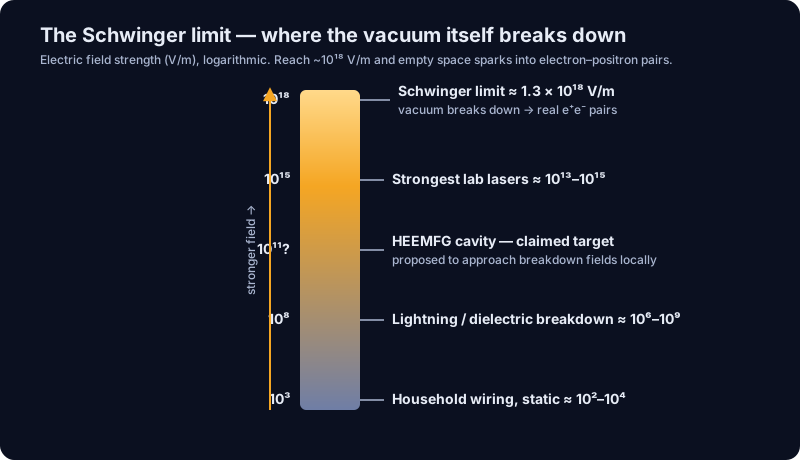
We agree with almost all of this, and it is why the whole chapter sits at Contested. Patents certify legal novelty, not physical reality; the Sheehy attestation is an official's sworn belief plus an unpublished internal demo, not a peer-reviewed result. And the quantitative critique is brutal: to truly polarize the vacuum you need fields near the Schwinger limit (Equation 7.1), and craft-scale hardware falls short by many orders of magnitude. The honest position is not "the Navy has antigravity" and not "Pais is a fraud" — it is: a real institution filed and briefly defended extraordinary claims, and those claims remain entirely unreplicated. The falsifier is clean and unmet — an independent, pre-registered replication at the specified parameters detecting the effect above noise.
Confidence ledger
- The patents exist, are Navy-assigned, and Sheehy attested "operability" to the USPTO. Definitive
- A patent grant / attestation constitutes scientific proof the effect is real. Contested (category error).
- The Pais Effect (EM-flux inertial-mass reduction / HFGW) is a real physical phenomenon. Contested
- Craft-scale fields can approach the Schwinger regime and polarize the vacuum. Speculative → Contested
- Falsifier: an independent, pre-registered replication at the patents' specified drive conditions detecting the claimed inertial-mass reduction or HFGW signal above noise. None has been reported.
Sources
The patents are public records (all downloaded); the physics is Contested - no independent replication exists.
Primary - the patents
- US10144532B2, "Craft using an inertial mass reduction device," S. C. Pais / US Navy, granted 2018-12-04. Google Patents.
- US20170313446A1 - the pre-grant application publication of that same craft invention (issued as US10144532B2). Widely mislabeled as a separate gravitational-wave patent; it is not.
- US10322827B2, "High frequency gravitational wave generator," Pais / US Navy, granted 2019-06-18 - the actual HFGW patent (invokes the Gertsenshtein effect). Google Patents.
- US20190058105A1, "Piezoelectricity-induced Room Temperature Superconductor" - abandoned Nov 2019 after an unanswered USPTO rejection.
- J. Schwinger (1951), "On gauge invariance and vacuum polarization," Phys. Rev. 82, 664 - the ~1.3e18 V/m threshold the claimed device sits many orders of magnitude below.
The evidentiary basis, sourced honestly
- The Sheehy attestation via FOIA: The War Zone, "Navy's Advanced Aerospace Tech Boss Claims Key 'UFO' Patent Is Operable" - Naval Aviation Enterprise CTO Dr. James Sheehy told the USPTO the invention was "operable" and cited an internal demo. This is an attestation plus an unpublished demo, not peer-reviewed data.
Answering the critics
- The War Zone / The Drive investigation (2019-2021): every physicist consulted over ~2 years found no basis for the "Pais Effect" and called the patent language pseudoscientific.
- Several Pais patents have lapsed for non-payment and the superconductor application was abandoned - the Navy did not sustain them.
Provenance discipline: a patent tests novelty/utility on paper, not physical reality. Treating a grant or a CTO letter as scientific evidence is a category error - the falsifier (an independent replication at the specified drive conditions) remains unmet.