Inertial Mass Reduction and Transmedium Craft
If inertia is vacuum drag, could you 'lubricate' space — and is that what the UAP videos show?
Here two threads from earlier in the book come together, and the knot must be tied with care. This is where a real observational puzzle gets fused to a highly speculative mechanism. The two must never be allowed to prop each other up.
The idea, as a conditional
Chapter 3 floated an idea: inertia is a reaction force from the vacuum. It is the resistance you feel when you push matter through the zero-point field. Chapter 7 described a claimed electromagnetic way to disturb that field. Put the two together and you get the boldest claim in the book.
IF inertia is vacuum drag, THEN thinning or restructuring the vacuum around a craft would cut its effective mass. The craft could then accelerate at thousands of g with no reaction mass. It could also slip between air, water, and space, because it barely interacts with any of them.
Harold Puthoff and colleagues laid out the theory in a 2002 paper on "engineering the zero-point field and polarizable vacuum for interstellar flight." Notice the shape of it. This is an if-then, and its "if" is Chapter 3's Contested idea. An if-then is never stronger than its "if."
The observations that make people wonder
The empirical hook is the U.S. Navy's declassified UAP videos — GIMBAL, GOFAST, FLIR1 — and the testimony around them. Witnesses describe objects that seem to accelerate, stop, and turn in ways no known aircraft could survive. In a peer-reviewed 2019 paper in Entropy, former NASA scientist Kevin Knuth and colleagues did the math. They estimated the accelerations implied if the sensor data are taken at face value. The numbers were extraordinary — hundreds to thousands of g.
That conditional clause is doing all the work, and honesty requires putting it in bold.
The decisive fork: are the kinematics even real?
This is where the chapter turns. Detailed analyses argue the headline motions are sensor artifacts. The most prominent come from Mick West and the Metabunk community, and parts of the U.S. government's own 2024 AARO report agree. The "impossible" rotation in GIMBAL matches the camera's own gimbal roll. GOFAST's "low, fast" object is, by parallax, plausibly a distant, slow one. If that holds, the whole premise of strange motion evaporates — before any exotic physics is needed at all.
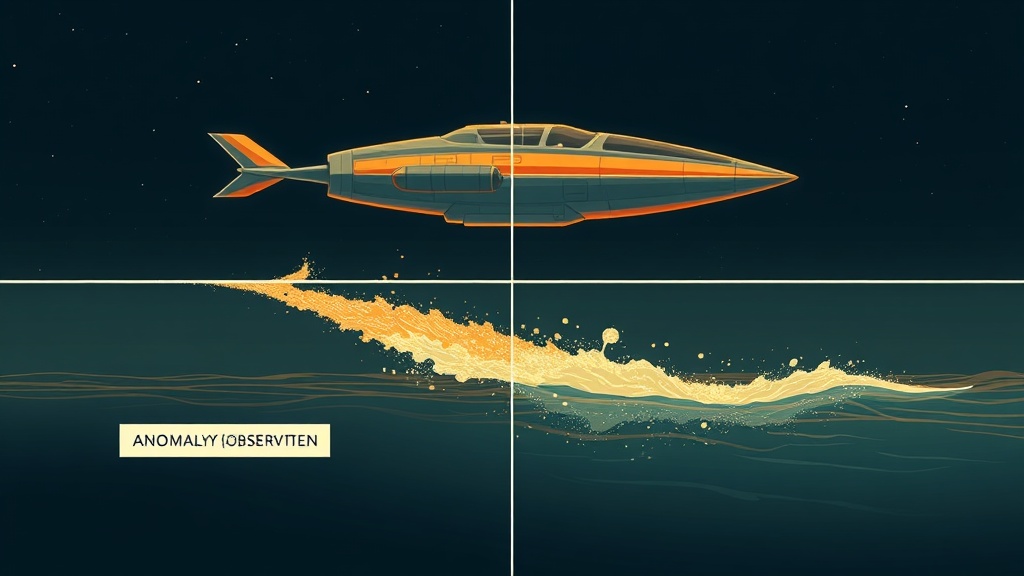
There is a second, physical falsifier. A solid object hitting water at hypersonic speed would make violent cavitation and shock heating. Those signatures are conspicuously absent from any released data. A real transmedium craft should leave a wake. None is on record.
Contested That the famous UAP-video accelerations are real object kinematics rather than sensor artifacts is disputed, and substantially disfavored for the specific headline cases.
Compounded uncertainty
The mechanism here is doubly unproven. It leans on Chapter 3 (ZPF-inertia, Contested) and on Chapter 7 (Pais-style actuation, Contested). A chain of Contested links does not average out to "plausible." It multiplies toward "very unlikely as a complete working system." We say that plainly, rather than let the drama of the videos paper over it.
“The 'anomalous' videos are explained by parallax, glare, and camera-gimbal rotation. And the U.S. government's own 2024 review found no evidence of exotic craft or reverse-engineering programs. There is no anomaly here for exotic physics to explain.”
This is the strongest position, and we largely grant it for the headline cases: the GIMBAL/GOFAST reconstructions are compelling, the transmedium wake signatures are missing, and the 2024 AARO Historical Record Report is pointedly deflationary. So we do not claim the videos are evidence of inertial-mass-reduction craft. What survives is narrower and more defensible: some UAP reports remain genuinely unexplained (Suggestive), which is a reason to keep measuring — not a licence to install an unproven mechanism as the explanation. The exotic reading stays at Contested precisely because its anomaly is disputed and its mechanism is doubly unproven.
Confidence ledger
- Some UAP reports involve genuinely unexplained observations. Suggestive
- The headline Navy-video "extreme accelerations" are real object kinematics, not artifacts. Contested
- IF inertia is vacuum drag, THEN local vacuum modification reduces effective mass. Speculative (conditional; inherits Chapter 3).
- Observed UAP are transmedium craft using inertial-mass reduction. Contested
- Falsifier: a physical craft in hand, or a full sensor-artifact plus mundane-object accounting of the catalogued cases (largely achieved by AARO for the headline videos).
Sources
Keep the anomaly (observed kinematics) rigorously separate from the mechanism (unproven, and doubly-inherited from Ch. 3 and Ch. 7).
Mechanism side (inherits Ch. 3 / Ch. 7)
- H. Puthoff, S. Little & M. Ibison (2002), "Engineering the zero-point field and polarizable vacuum for interstellar flight," JBIS 55, 137 (arXiv:physics/9908050) - the closest thing to a primary theoretical statement of "modify the vacuum -> reduce effective inertia." (Downloaded.)
Anomaly side - the quantified, peer-reviewed version (beyond the source corpus)
- K. Knuth, R. Powell & P. Reali (2019), "Estimating flight characteristics of anomalous unidentified aerial vehicles," Entropy 21(10), 939 (open access) - a former NASA scientist's kinematic bound, explicitly conditioned on "if the sensor data are taken at face value."
Answering the critics (the decisive fork)
- US DoD/AARO (2024), Historical Record Report, Volume 1 - found no evidence of exotic craft or reverse-engineering programs; notably deflationary.
- ODNI (2021), Preliminary Assessment: Unidentified Aerial Phenomena.
- Sensor-artifact analyses (Mick West / Metabunk) of GIMBAL/GOFAST/FLIR1 - parallax, gimbal rotation and glare reproduce the headline imagery from mundane objects. If the videos show artifacts, the "anomalous kinematics" premise collapses with no exotic physics.
- Falsifier the chapter states plainly: a real object entering water at hypersonic speed would leave cavitation and shock-heating signatures - absent from any released data.