Space, time, motion, and reference frames
Learn why coordinates describe events but do not dictate what every observer measures.
Begin with position, clocks, and relative motion, then reach the invariant spacetime interval without requiring advanced algebra.
Before you begin
- • Course 1: Measurement
- • Course 3: Waves
By the end, you can
- • Describe events using coordinates and clock readings.
- • Compare motion from different reference frames.
- • Explain why light forces space and time measurements to mix.
- • Distinguish a coordinate effect from an invariant measurement.
Interactive model
Explore before calculating
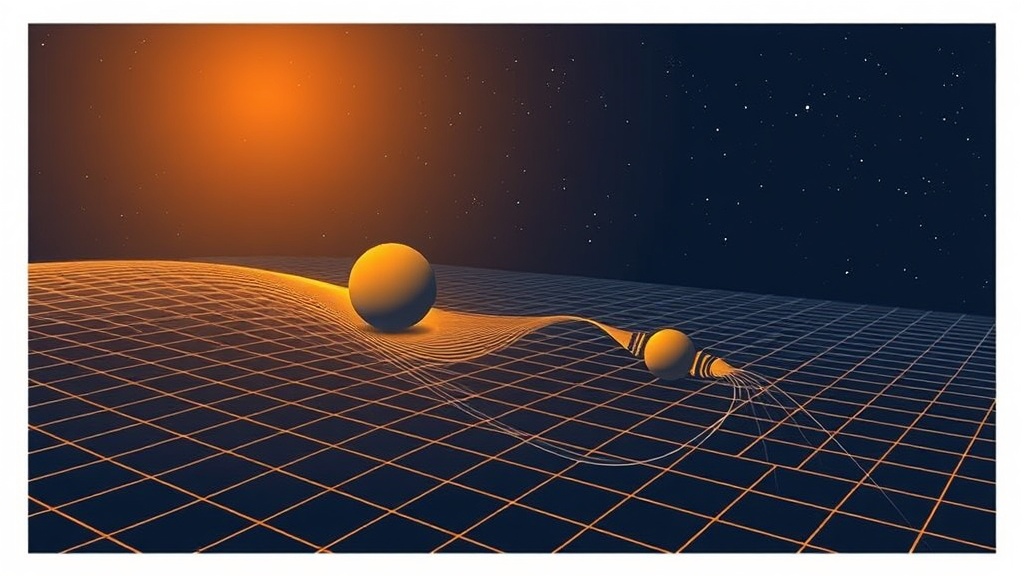
Live laboratory
Two-frame light-clock studio
Keep one clock's own elapsed time fixed while changing its speed relative to a laboratory. The two frames disagree about time and distance but recover the same spacetime interval.
Lorentz factor γ: 1.2500
Laboratory elapsed time: 12.500 µs
Laboratory distance: 2.248 km
Light path cΔt: 3.747 km
Recovered interval: 2.998 km
Clock-frame cτ: 2.998 km
The laboratory assigns the moving clock a longer coordinate time and a nonzero distance. Subtracting the spatial part from the light-distance part recovers cτ, the same invariant interval carried by the clock.
The drawing is a normalized geometry aid; the numerical ledger uses the exact flat-spacetime relation c²Δt²−Δx²=c²τ². Acceleration, gravity, clock construction, and synchronization procedures are outside this two-event inertial model.
Level 1 · Foundations teaching kit
Record the investigation. Teach the reasoning.
A learner-facing lab record and a course-specific instructor guide turn the live model into a repeatable classroom investigation.
Learner record
Two-frame light-clock record
How can laboratory time and distance change while the clock's own spacetime interval stays fixed?
Download learner recordInstructor guide
Teach for evidence, not button pushing
Learners distinguish coordinate descriptions from an invariant interval using a numerical light-clock model.
Download instructor guideLesson 1 of 3
Events and reference frames
How can two observers describe one motion differently without either being wrong?
An event is something occurring at a place and time. A reference frame supplies coordinates and synchronized clocks for labeling events.
Velocity is relative to a chosen frame. A passenger can be at rest relative to a train while moving relative to the ground.
Worked example
A passenger walks forward at 1 m/s inside a train moving at 20 m/s relative to the ground.
- 1. Train frame: passenger speed is 1 m/s.
- 2. Ground frame at ordinary speeds: add velocities.
- 3. 20 + 1 = 21 m/s.
Both 1 m/s and 21 m/s are correct because they use different reference frames.
Try it
Two-frame video
Materials: A rolling toy or ball and a phone camera.
- 1. Record the object from a stationary camera.
- 2. Record while moving alongside it.
- 3. Mark the same two events in both videos.
- 4. Compare the coordinate motion.
Notice: The path depends on the frame, while the physical meetings between objects are shared events.
Check your understanding: Is a speed meaningful without saying ‘relative to what’?
Answer: No.
Velocity is defined relative to a reference frame.
Lesson 2 of 3
Light clocks and invariant speed
What must change if every inertial observer measures the same speed of light?
Maxwell's theory and experiment identify one invariant light speed in vacuum. If observers in relative motion all measure that same value, everyday assumptions about universal time cannot remain exact.
Moving clocks accumulate different elapsed time between shared events. This is measured physics, not an optical illusion.
Worked example
A light pulse travels a longer diagonal path in a moving light clock than in the clock's own frame.
- 1. Both observers use the same light speed.
- 2. The moving-frame path is longer.
- 3. A longer path at the same speed requires more coordinate time.
The geometry requires time dilation; the effect is confirmed by particle lifetimes and precision clocks.
Try it
Paper light-clock geometry
Materials: Graph paper, ruler, and pencil.
- 1. Draw a vertical light path for a stationary clock.
- 2. Shift the top mirror sideways and draw the diagonal moving path.
- 3. Measure both path lengths.
- 4. Ask what must happen if speed is unchanged.
Notice: The diagonal path is longer, giving a geometric route to time dilation.
Check your understanding: In special relativity, do different inertial observers measure different vacuum light speeds?
Answer: No.
They agree on c; their space and time coordinate intervals adjust consistently.
Lesson 3 of 3
The spacetime interval
What quantity can observers in relative motion agree on?
Observers can disagree about spatial distance and elapsed coordinate time while agreeing on the spacetime interval between events.
A metric is the rule that computes that interval. In flat spacetime it combines time and space with a minus sign; in curved spacetime the rule varies by location.
Worked example
Why is a metric more than a drawn grid?
- 1. Coordinates are labels that can be changed.
- 2. The metric converts label differences into physical intervals.
- 3. Predictions depend on invariant intervals, not the artistic grid.
The metric is a measurement rule; grid distortion is only a visualization.
Try it
Coordinates versus distance
Materials: A map with latitude and longitude or an online globe.
- 1. Choose two pairs of points separated by one degree of longitude.
- 2. Compare one pair near the equator and one near a pole.
- 3. Measure approximate ground distances.
- 4. Relate the changing conversion to a metric.
Notice: Equal coordinate differences need not represent equal physical distances.
Check your understanding: What does a metric do?
Answer: It converts coordinate differences into physical spacetime intervals.
It is the local measurement rule for distances, times, and causal structure.
Continue into the evidence