From Wonder to Work: The Unified Picture and an Honest Ledger
The convergence thesis, its weakest load-bearing link, and a research program you can run yourself.
We have climbed from measured lab fact to unreplicated fringe claim, tagging every rung. Now we assemble the whole picture. The assembly itself must be graded, because a chain is not the average of its links. This closing chapter states the strongest honest version of the thesis. It names the fatal weak point. And it shows how you can keep investigating without us.
The convergence thesis
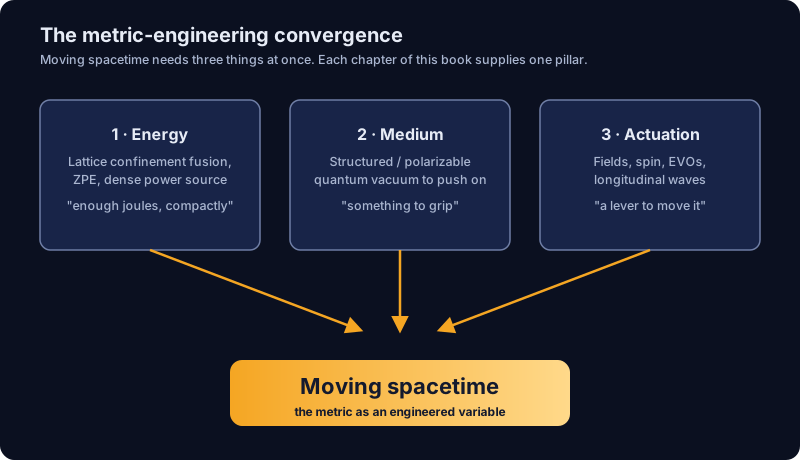
The unifying idea comes from Harold Puthoff's 2010 DIA reference document. Three ingredients, each explored in this book, might one day combine into propulsion that moves spacetime instead of throwing propellant:
- Energy — a compact, high-density source (Chapter 12's lattice fusion is the most credible candidate).
- Medium — a vacuum that is real, structured, and possibly a superfluid condensate (Chapters 2, 5).
- Actuation — some way to drive that medium: high-frequency resonance, spin, phase conjugation, or coherent charge (Chapters 7, 8, 10, 11).
It is a genuinely elegant synthesis. As an integrated working technology, it is also unproven. The reason is arithmetic, not attitude.
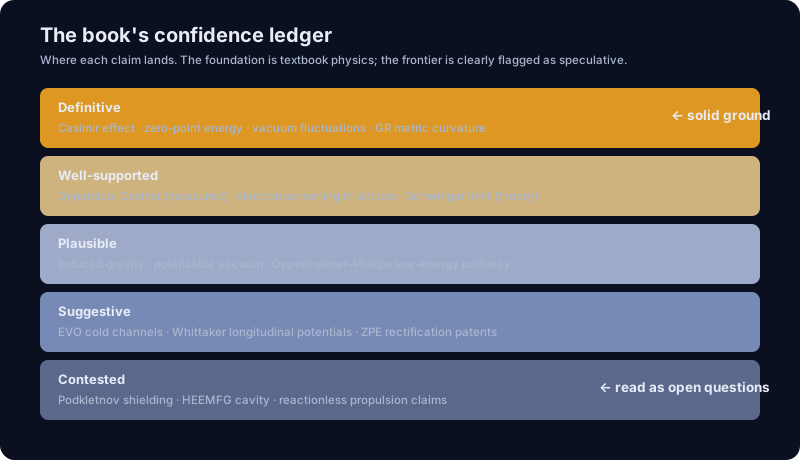
The book-level ledger
Laid side by side, the pillars land at very different tiers:
- The vacuum is real, structured, and couples to matter (Casimir, DCE). Definitive
- General relativity admits warp and wormhole metrics. Definitive (as mathematics).
- Those metrics require exotic/negative energy; a moving warp drive violates the null energy condition (Santiago–Schuster–Visser 2021), while subluminal positive-energy shells may be permissible (Bobrick–Martire 2021). Definitive / Suggestive
- Emergent / superfluid vacuum and emergent gravity. Strong (theory) / Suggestive (as our reality).
- Compact high-density energy — lattice confinement fusion. Strong (reactions) / Contested (net power).
- Actuation — Pais / scalar / gravity-control. Contested (no independent replication of any mechanism).
- The integrated "metric-engineering craft" exists or is near. Contested → Speculative
Notice what this ledger refuses to do. It does not dismiss the whole enterprise — several pillars are textbook or peer-reviewed. It does not endorse the craft — its load-bearing link has never replicated. Both moves would be cheaper, and both would be wrong.
Where the serious institutions actually put the line
This is not a lone-crank field. NASA chartered the Breakthrough Propulsion Physics program (1996–2002) under Marc Millis to ask exactly these questions. The AIAA published Frontiers of Propulsion Science (Millis & Davis, 2009) as a sober survey. Their verdict is the one we land on: the questions are legitimate; the answers remain unrealized. Institutional interest is real. A working device is not.
MH370, one last time
Throughout, MH370 has appeared only as a worked example. Chapter 9 showed the footage is strongly disfavored as authentic (RegicideAnon origin, stock-cloud match, VFX reproducibility). The right way to hold it is as modern folklore that happens to rhyme with the research. Its shape echoes real ideas about orbs, plasmoids, and vanishing — without being evidence for any of them. A myth can track a science without confirming it. That distinction is the whole discipline of this book in miniature.
Your own research program
The real payoff is a habit you can carry into any extraordinary claim, in this field or any other:
- State the claim precisely enough to be wrong.
- Tier it — Definitive to Contested — on the actual evidence, not the excitement.
- Write its falsifier in advance: what result would kill it?
- Separate independent corroboration from echo — is it three unrelated sources, or one traced through ten mouths?
- Name the next measurement that would move the tier.
- Follow it even to "no." Model yourself on Tajmar (Chapter 11), who improved his own experiment until his exciting signal dissolved — and reported it.
“You've spent a whole book taking fringe propulsion ideas seriously, then admitted the key link is unproven. Isn't the honest one-sentence verdict just: 'there is no evidence any of this works, so why give it a book'?”
Because two different sentences are both true, and collapsing them loses information. "There is no independently replicated working craft" is correct — and so is "several of the underlying pillars are textbook physics, peer-reviewed NASA results, or active mainstream research fronts." A book that only said the first would miss that the Casimir effect, gravitomagnetism, the dynamical Casimir effect, emergent-gravity analogues, and lattice-fusion reactions are real. A book that only said the second would be hype. The defensible thesis — kept in view on every page — is this: the questions are real and partly mainstream; the pillars range from Definitive to Contested; and the integrated working technology is unproven, its weakest link (actuation) unreplicated. Keep the wonder. Keep the brakes.
Confidence ledger
- Individual pillars span Definitive (vacuum reality, GR metrics) to Contested (actuation mechanisms).
- The unified "metric-engineering craft" exists or is near. Contested → Speculative
- MH370 orbs are evidence for the thesis. Contested (rejected as evidence; retained only as illustration).
- Falsifier for the whole thesis: a physical craft in hand, or an independent replication of any actuation mechanism with a closed energy ledger. Equally, a proof that quantum inequalities forbid the required negative energy would shut the moving-warp route. Until one of those lands, the honest verdict is uncertainty — graded, link by link, exactly as tabled above.
Sources
A synthesis chapter - its sources are the load-bearing anchors of the pillars it weighs, plus the institutional record that the questions are legitimate.
The convergence thesis, stated in the corpus's own terms
- H. Puthoff (2010), "Advanced Space Propulsion Based on Vacuum (Spacetime Metric) Engineering," JBIS 63, 82 (arXiv:1204.2184). (Downloaded.)
The institutional record - the questions are legitimate (beyond the source corpus)
- M. Millis (1998), "Breakthrough Propulsion Physics Program," NASA NTRS 19980201240 - NASA officially chartered exactly these questions, 1996-2002. (Downloaded.)
- M. Millis & E. Davis (eds.), Frontiers of Propulsion Science (AIAA Progress in Astronautics 227, 2009) - the sober, credentialed survey volume.
The current peer-reviewed frontier (from Ch. 4)
- A. Bobrick & G. Martire (2021), arXiv:2102.06824; S. Santiago, J. Schuster & M. Visser (2021), arXiv:2105.03079 - subluminal warp shells may be physical; moving warp drives still violate the NEC.
Answering the critics (the deflationary bookends)
- US DoD/AARO (2024), Historical Record Report, Vol. 1 - no evidence of exotic craft or reverse engineering.
- MH370 debunk (full detail in Ch. 9): Skeptical Inquirer "The MH370 Teleport Hoax" (2024); Metabunk 13104 - the footage is folklore that rhymes with the research, not evidence for it.
The compounded-uncertainty rule: a chain of Contested links does not average to "plausible" - it multiplies to "very unlikely as a complete working system." The thesis is only as strong as its weakest independent link, and that link (actuation) has no independent replication.