Special relativity without shortcuts
Use events, light cones, Lorentz transformations, and four-vectors quantitatively.
Move beyond slogans to the invariant interval, time dilation, length contraction, relativistic momentum, and causal structure.
Before you begin
- • Level 1 spacetime course
- • Mechanics
- • Algebra and square roots
By the end, you can
- • Calculate Lorentz factors and time dilation.
- • Use the invariant interval to classify event separation.
- • Relate energy and momentum relativistically.
- • Explain why local motion never exceeds c in a warp metric.
Interactive model
Explore before calculating
Live laboratory
Light-cone event classifier
Move a second event in space and time. The invariant interval—not an observer's drawing alone—classifies their causal relationship.
timelike: Δs² = 8.94 km². A slower-than-light signal could connect the events, and their time order is invariant.
Level 2 · Secondary physics teaching kit
Record the investigation. Teach the reasoning.
A learner-facing lab record and a course-specific instructor guide turn the live model into a repeatable classroom investigation.
Learner record
Light-cone interval and causality atlas
Which event pairs can exchange a signal, and which descriptions remain invariant when coordinates change?
Download learner recordInstructor guide
Teach for evidence, not button pushing
Learners classify event separation from the invariant interval and distinguish coordinates from causal structure.
Download instructor guideLesson 1 of 3
Lorentz factor and moving clocks
How much proper time accumulates along different inertial paths?
The Lorentz factor γ = 1/√(1−v²/c²) quantifies how strongly space and time coordinates mix. At everyday speed γ is almost one.
Proper time is what a clock records along its own path. Between the same departure and reunion events, different paths can accumulate different proper times.
Worked example
A spacecraft moves at 0.80c. Find γ.
- 1. Compute v²/c² = 0.64.
- 2. Compute √(1−0.64) = 0.60.
- 3. Take the reciprocal.
γ ≈ 1.67; 1.0 ship-year spans about 1.67 years in the chosen Earth frame.
Try it
Lorentz-factor table
Materials: Calculator and spreadsheet or graph paper.
- 1. Compute γ at 0, 0.1c, 0.5c, 0.8c, 0.95c, and 0.99c.
- 2. Plot γ versus v/c.
- 3. Identify the nonlinear region.
- 4. Explain why no finite γ reaches c.
Notice: Relativistic effects grow sharply near c rather than linearly with speed.
Check your understanding: Does time dilation mean one observer's clock mechanism is defective?
Answer: No.
Each local clock runs normally; elapsed time depends on the spacetime path between compared events.
Lesson 2 of 3
Invariant intervals and light cones
Which events can influence one another?
The interval combines temporal and spatial separation in a quantity all inertial observers agree on. Timelike-separated events can be connected by slower-than-light motion; lightlike events by light; spacelike events cannot be causally linked without superluminal influence.
Observers may disagree on the time order of spacelike events, but they agree on the causal classification.
Worked example
Two events are 5 light-seconds apart in space and 3 seconds apart in time.
- 1. Light could cross only 3 light-seconds in 3 seconds.
- 2. Spatial separation exceeds cΔt.
- 3. Classify the interval as spacelike.
No signal traveling at or below c can connect the events in that frame, and all inertial observers agree they are spacelike.
Try it
Draw a light-cone map
Materials: Graph paper with ct vertical and x horizontal.
- 1. Draw 45° light rays from an event.
- 2. Place timelike, lightlike, and spacelike examples.
- 3. Draw a slower observer worldline.
- 4. Test which points can receive a signal.
Notice: The cone is a causal boundary, not a physical shell traveling through space.
Check your understanding: Can two inertial observers disagree about whether two events are spacelike?
Answer: No.
The interval classification is invariant even when coordinate differences change.
Lesson 3 of 3
Relativistic energy and momentum
What replaces classical kinetic-energy formulas near light speed?
Relativistic momentum p = γmv grows without bound as a massive object approaches c. Total energy and momentum obey E² = (pc)² + (mc²)².
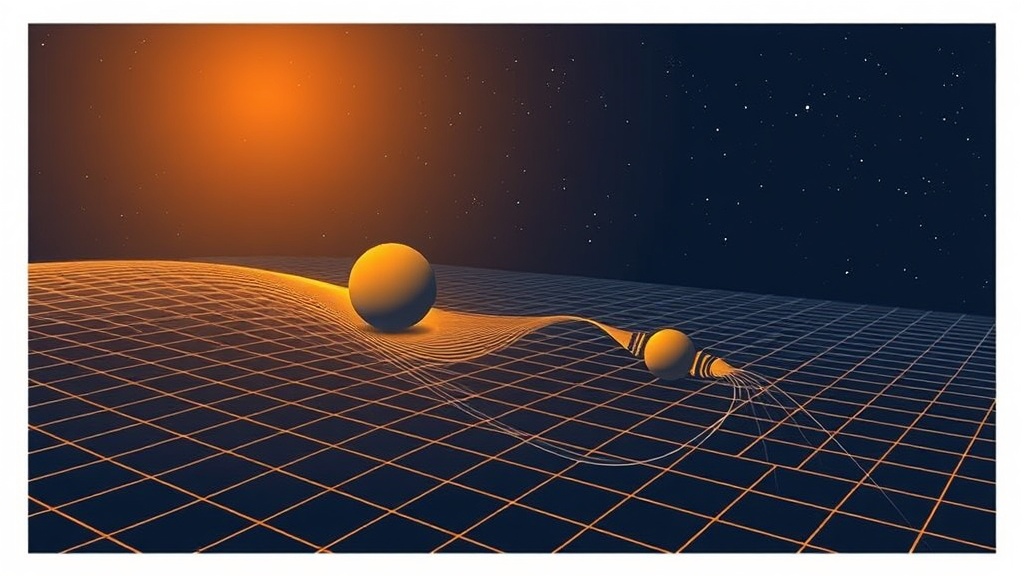
Light has zero rest mass but nonzero energy and momentum. A warp spacetime proposal changes geometry rather than accelerating a local craft through c.
Worked example
Find the total energy of a 1 kg object at 0.80c in units of its rest energy.
- 1. Use E = γmc².
- 2. At 0.80c, γ ≈ 1.67.
- 3. Divide by mc².
Total energy is about 1.67 times rest energy; kinetic energy is about 0.67mc².
Try it
Classical-versus-relativistic comparison
Materials: Calculator or spreadsheet.
- 1. Compute classical ½mv² and relativistic (γ−1)mc² at several v/c values.
- 2. Normalize both by mc².
- 3. Plot the difference.
- 4. Mark where classical error exceeds 1%.
Notice: Classical mechanics is an excellent low-speed approximation and fails progressively near c.
Check your understanding: Why can light carry momentum without rest mass?
Answer: For m = 0, the energy-momentum relation becomes E = pc.
Rest mass is not required for relativistic momentum.
Formula-to-meaning deck
Read the equation in ordinary language.
γ = 1/√(1−v²/c²)
Lorentz factor measures relativistic mixing at speed v.
Units: dimensionless
Δs² = c²Δt² − Δx²
The spacetime interval is invariant between inertial frames.
Units: m²
E² = (pc)² + (mc²)²
Energy, momentum, and rest mass form one relativistic relation.
Units: J²
Independent practice
Problem set
Work each problem before opening its hint and solution.
1. Find γ at 0.60c.
Reveal hint
Compute 1/√(1−0.36).
Reveal solution
γ = 1.25.
2. A muon experiences 2.2 μs while moving with γ = 10. What lifetime is measured in the lab frame?
Reveal hint
Δt = γΔτ.
Reveal solution
22 μs.
3. A photon has energy 3.0 eV. Express its momentum symbolically.
Reveal hint
Set m = 0 in the energy-momentum relation.
Reveal solution
p = E/c = 3.0 eV/c.
Continue into the evidence