Lecture 545 min 11 sec
The Morris–Thorne wormhole
A traversable shortcut through spacetime—and the cost of holding it open.
Season 1 · remastered lesson
Watch the full lecture
45 min 11 sec · Captions: English · Español · Português · Français · Polski
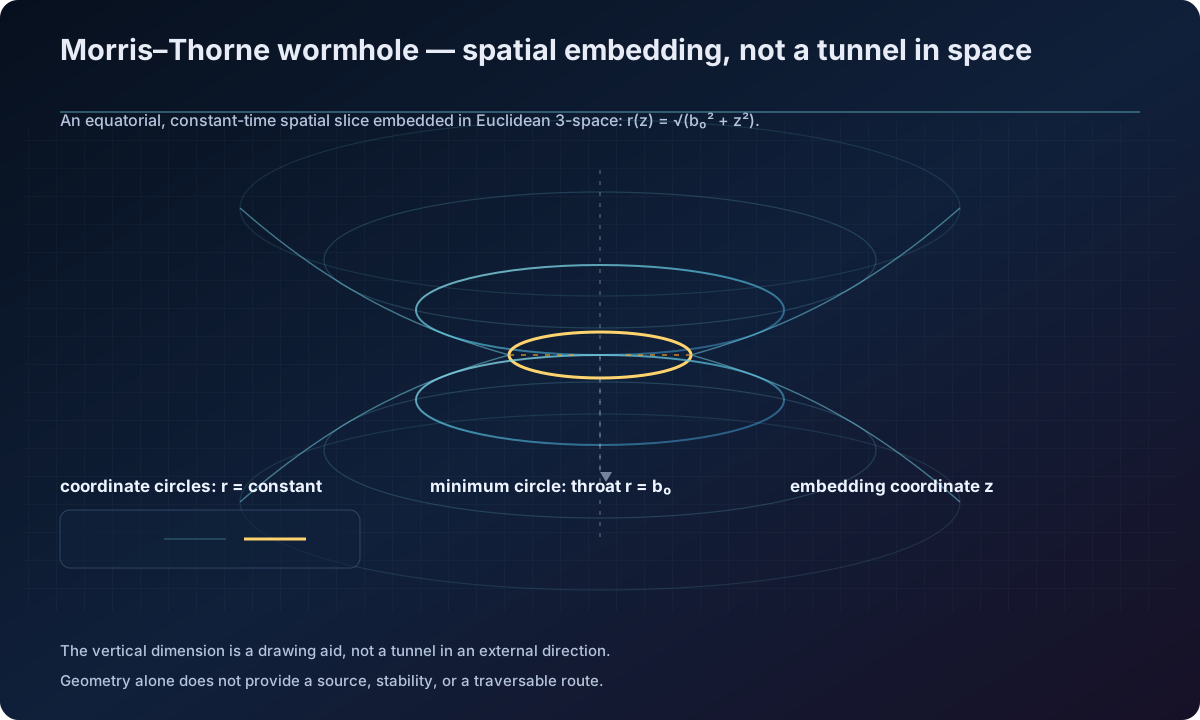
A Morris–Thorne wormhole spatial embedding: coordinate circles, a minimum throat circle, and an embedding coordinate. The vertical direction is a drawing aid, not a tunnel in an outside direction.
Use the arrow keys to change the speed.
Playback speed: normal.
Visual explanation
Explore the central idea
Motion is optional · static explanation always available
Read alongside
Wormholes, Energy Conditions, and the Negative-Energy Budget
The experiments, equations, and original papers behind the lesson.
Open the companion chapter →Retrieval practice
Check your understanding
A few questions on this lecture. Choose an answer, then check it. Nothing is saved or sent anywhere.