The Spacetime Metric
Lecture 850 min 32 sec

The Casimir effect, measured

How an abstract vacuum prediction becomes a laboratory force.

Season 1 · remastered lesson

Watch the full lecture

50 min 32 sec · Captions: English · Español · Português · Français · Polski

Historical reconstruction · the 1958 flat-plate measurement

Use the arrow keys to change the speed.

Playback speed: normal.

Read the transcript

Visual explanation

Explore the central idea

Motion is optional · static explanation always available
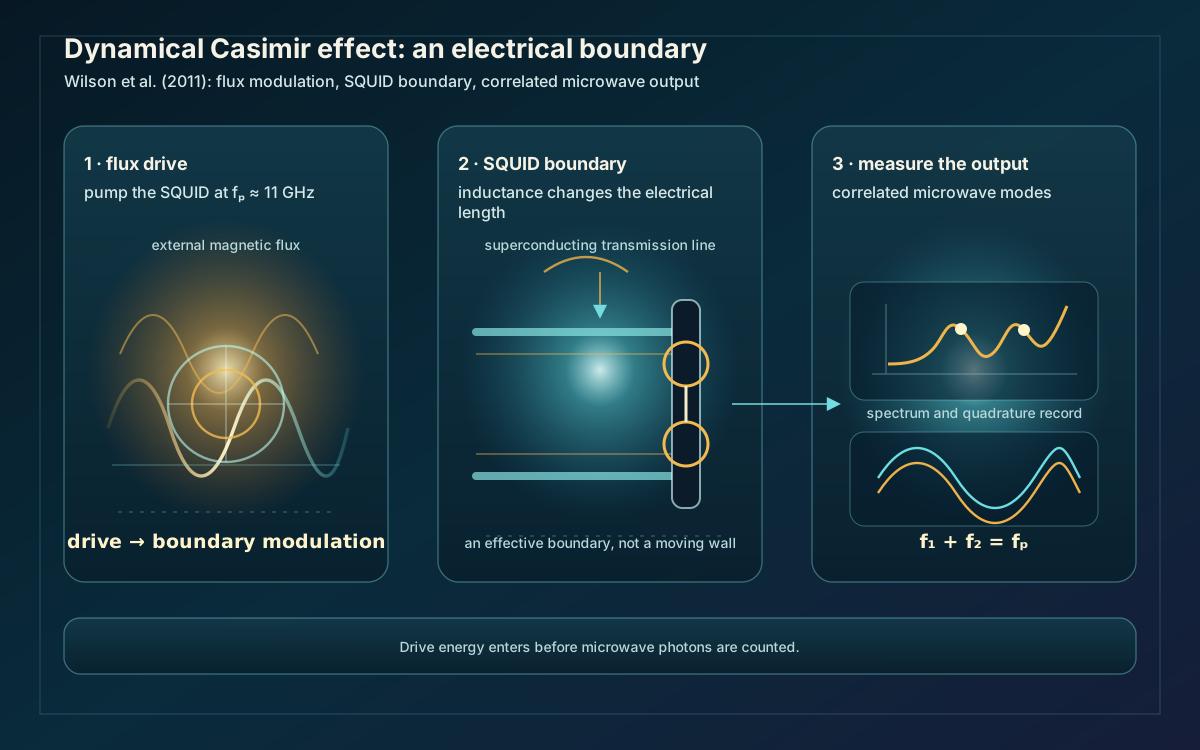
A flux-driven SQUID boundary producing correlated microwave modes in a superconducting transmission line.
Rapidly changing an effective electrical boundary can convert fluctuations into correlated microwave photons. The input drive supplies energy; the observation does not establish a free-energy source.

Read alongside

Casimir Physics and Vacuum-Force Engineering

The experiments, equations, and original papers behind the lesson.

Open the companion chapter →

Retrieval practice

Check your understanding

A few questions on this lecture. Choose an answer, then check it. Nothing is saved or sent anywhere.

  1. Question 1 of 4 · Predict firstBefore you check: two uncharged, flat, parallel metal plates sit a micron apart in vacuum. What do you expect them to do?
  2. Question 2 of 4What difference between the inside and the outside of the gap produces the Casimir force?
  3. Question 3 of 4 · Predict firstBefore you check: the Casimir force scales as the inverse fourth power of the gap. What do you expect happens each time you halve the gap?
  4. Question 4 of 4In the dynamical Casimir effect, what happens when a boundary moves fast, on a timescale comparable to or shorter than the inverse of the cavity-mode frequency?