The Spacetime Metric
Lecture 742 min 1 sec

Quantum field theory and the vacuum

The vacuum is the lowest-energy state, not an empty stage.

Season 1 · remastered lesson

Watch the full lecture

42 min 1 sec · Captions: English · Español · Português · Français · Polski

Three panels distinguish a field state, boundary conditions, and an observable. The curves are allowed modes and a distribution, not particles moving through a material vacuum.

Use the arrow keys to change the speed.

Playback speed: normal.

Read the transcript

Visual explanation

Explore the central idea

Motion is optional · static explanation always available
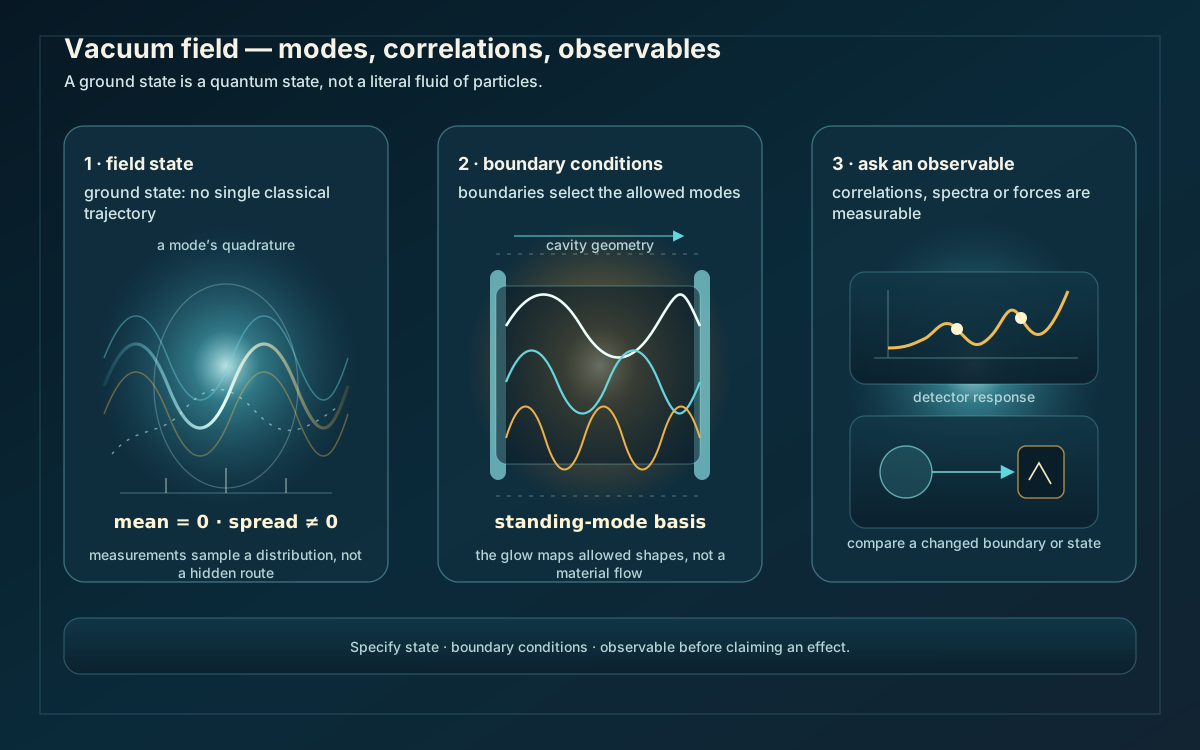
An idealized cavity with static field-mode bases and a diffuse state distribution.
A field can sit in its lowest-energy state without becoming featureless. The curves represent allowed mode shapes and a state distribution, not particles moving through empty space.

Read alongside

What Is the Vacuum?

The experiments, equations, and original papers behind the lesson.

Open the companion chapter →

Retrieval practice

Check your understanding

A few questions on this lecture. Choose an answer, then check it. Nothing is saved or sent anywhere.

  1. Question 1 of 4 · Predict firstBefore you check: what do you expect the lowest possible energy of a quantum harmonic oscillator to be?
  2. Question 2 of 4Why can't a quantum oscillator sit perfectly still at the bottom with zero energy?
  3. Question 3 of 4 · Predict firstBefore you check: a quantum field is in its vacuum state, with no photons and no real particles. What do you expect about its energy?
  4. Question 4 of 4According to the lecture, what do zero-point fluctuations of the electromagnetic field do to the electron in a hydrogen atom?