Why empty space is not simple
Meet fields, ground states, fluctuations, and the measured effects associated with the quantum vacuum.
Use oscillators and cavities to build a careful first picture of zero-point energy—what established theory predicts, what experiments measure, and what energy-extraction claims must still demonstrate.
Before you begin
- • Course 1: Evidence
- • Course 2: Fields and energy
- • Course 3: Waves and modes
By the end, you can
- • Define a ground state without calling it classical emptiness.
- • Explain zero-point motion using a quantum oscillator model.
- • Describe the Casimir effect through boundaries and measurable force.
- • Separate vacuum effects from demonstrated net-energy extraction.
Interactive model
Explore before calculating
Live laboratory
Closed-cycle Casimir work ledger
Follow ideal parallel plates through approach, capture, separation, and control reset. A measurable attractive interaction can deliver work on approach; returning the same system state closes the cycle.
Final gap: 100.00 nm
Approach work: 4.299e-10 J
Ideal separation work: 4.299e-10 J
Actuator overhead: 8.598e-11 J
Control input: 1.000e-9 J
Full-cycle net: -1.086e-9 J
In the ideal reversible limit, approach output and separation work are equal. Any actuator overhead, control, dissipation, switching, or reset cost makes the declared full-cycle net negative.
The displayed U=−π²ℏcA/(720a³) is the ideal perfect-conductor, zero-temperature parallel-plate expression. Real inference needs material dispersion, roughness, patch fields, alignment, finite geometry, thermal corrections, dynamics, and calibrated work measurement.
Level 1 · Foundations teaching kit
Record the investigation. Teach the reasoning.
A learner-facing lab record and a course-specific instructor guide turn the live model into a repeatable classroom investigation.
Learner record
Closed-cycle Casimir work record
Why does measurable work during plate approach not by itself create a repeatable net-energy source?
Download learner recordInstructor guide
Teach for evidence, not button pushing
Learners distinguish a measured Casimir interaction from a demonstrated repeatable net-energy cycle.
Download instructor guideLesson 1 of 3
The lowest state is not classical stillness
What remains when a quantum system has given up every removable unit of energy?
A ground state is the lowest-energy state allowed by a quantum system's rules. For a harmonic oscillator, exact rest would require both perfectly known position and perfectly known momentum.
Quantum uncertainty prevents that classical combination. The remaining ground-state energy is called zero-point energy.
Worked example
Why can cooling remove thermal vibration without removing all quantum motion?
- 1. Cooling reduces occupation of excited states.
- 2. The system approaches its ground state.
- 3. The ground state still obeys quantum uncertainty.
Thermal energy can approach zero while zero-point motion remains.
Try it
Classical versus quantum floor
Materials: Paper, pencil, and two labeled energy ladders.
- 1. Draw a classical ladder reaching zero.
- 2. Draw discrete quantum levels with a lowest level above the classical zero reference.
- 3. Move a marker downward as cooling occurs.
- 4. Identify what cannot be removed without changing the system.
Notice: The model distinguishes thermal excitation from the ground-state floor.
Check your understanding: Is zero-point energy simply heat left in an imperfect refrigerator?
Answer: No.
It is ground-state energy required by the quantum description, even as thermal excitation approaches zero.
Lesson 2 of 3
Vacuum means a field ground state
How can empty space have physical properties without being an ordinary material fluid?
In quantum field theory, particles are excitations of fields. A vacuum is a field state with no particles of the chosen type, not the absence of fields or physical law.
Vacuum language depends on the observer, boundaries, and spacetime. The old mechanical aether and the modern quantum vacuum are not interchangeable concepts.
Worked example
A quiet guitar string still exists even when no visible wave travels on it. How far does the analogy go?
- 1. The string resembles a field capable of modes.
- 2. A plucked pattern resembles an excitation.
- 3. But a quantum field is not assumed to be made of ordinary material string.
The analogy helps with modes but does not prove a mechanical substance beneath spacetime.
Try it
Analogy boundary table
Materials: Paper divided into ‘helps’ and ‘breaks’ columns.
- 1. Choose the ocean, a string, or a spring as a vacuum analogy.
- 2. List features that help explain fields and modes.
- 3. List features wrongly implying friction, a preferred frame, or ordinary matter.
- 4. Rewrite the analogy with its limits stated.
Notice: A strong analogy teaches both a similarity and the point where the comparison fails.
Check your understanding: Does modern quantum-field vacuum automatically restore the nineteenth-century mechanical luminiferous aether?
Answer: No.
Both reject naive emptiness, but they have different mathematical structures and experimental implications.
Lesson 3 of 3
Casimir forces and the energy question
What has been measured, and what would a cyclic energy device still need to prove?
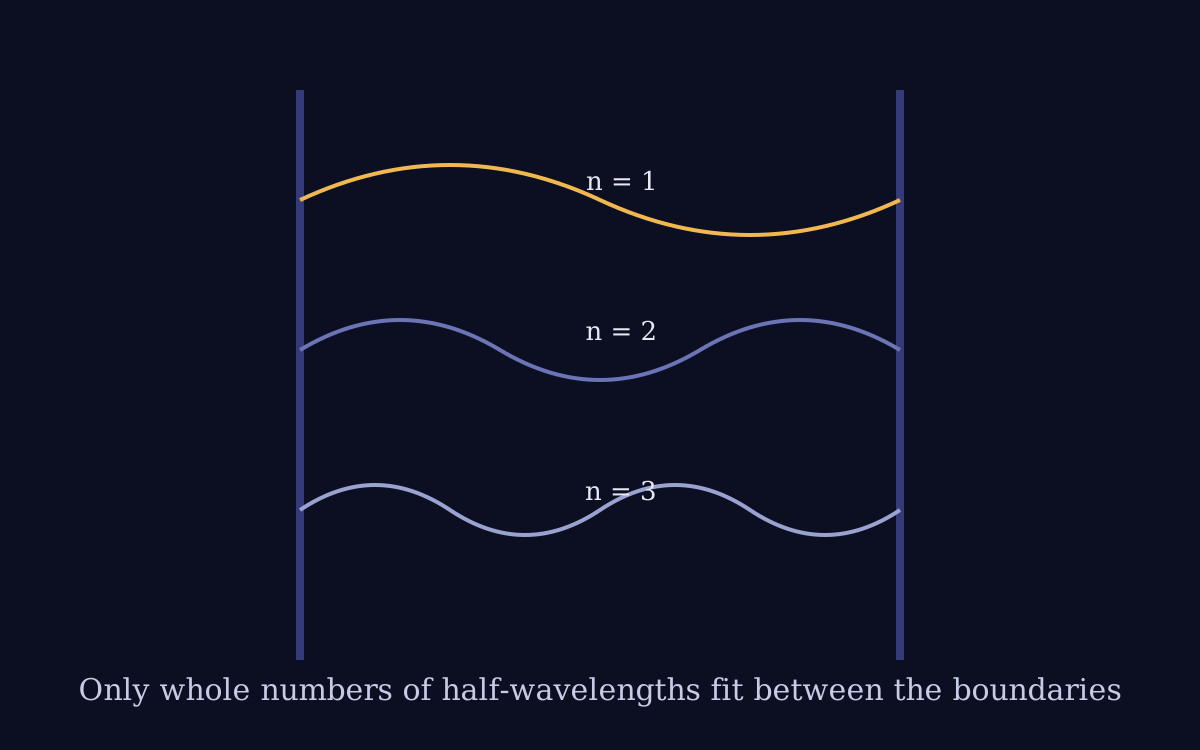
Closely spaced bodies experience forces predicted by quantum electrodynamics and material-response theory. Boundary geometry changes the allowed field modes and electromagnetic interactions.
A force over one part of a cycle is not automatically a net energy source. Returning the apparatus, switching boundaries, controlling losses, and measuring every input are part of the full cycle.
Worked example
Two plates attract and release mechanical energy as they move together. Has free energy been produced?
- 1. Measure work gained during attraction.
- 2. Include work required to separate or reset the plates.
- 3. Include switching, control, and loss energy.
- 4. Compare the complete initial and final states.
A measured attraction is established; net cyclic extraction requires a separate closed energy balance.
Try it
Closed-cycle ledger
Materials: Paper and a four-stage imaginary plate cycle.
- 1. Label approach, capture, separation, and reset stages.
- 2. Assign a signed energy transfer to each stage.
- 3. Include actuator and control inputs.
- 4. Sum the entire cycle rather than one favorable step.
Notice: The return path is usually where an apparent one-step energy gain must be repaid.
Check your understanding: What does a measured Casimir force establish?
Answer: That configured bodies experience the predicted boundary- and material-dependent interaction.
It does not alone establish a device that produces net energy over a repeatable cycle.
Continue into the evidence
Source-linked next reading
Chapter 2: What Is the Vacuum?
The main sourced introduction to vacuum states, ZPE, and Casimir physics.
Lecture 7: QFT and the vacuum
A field-and-mode account of the quantum vacuum.
Chapter 6: Getting Energy From the Vacuum
Examines dynamical boundaries and complete thermodynamic accounting.
Lecture 8: The Casimir effect, measured
The measurement pathway and its engineering boundary.